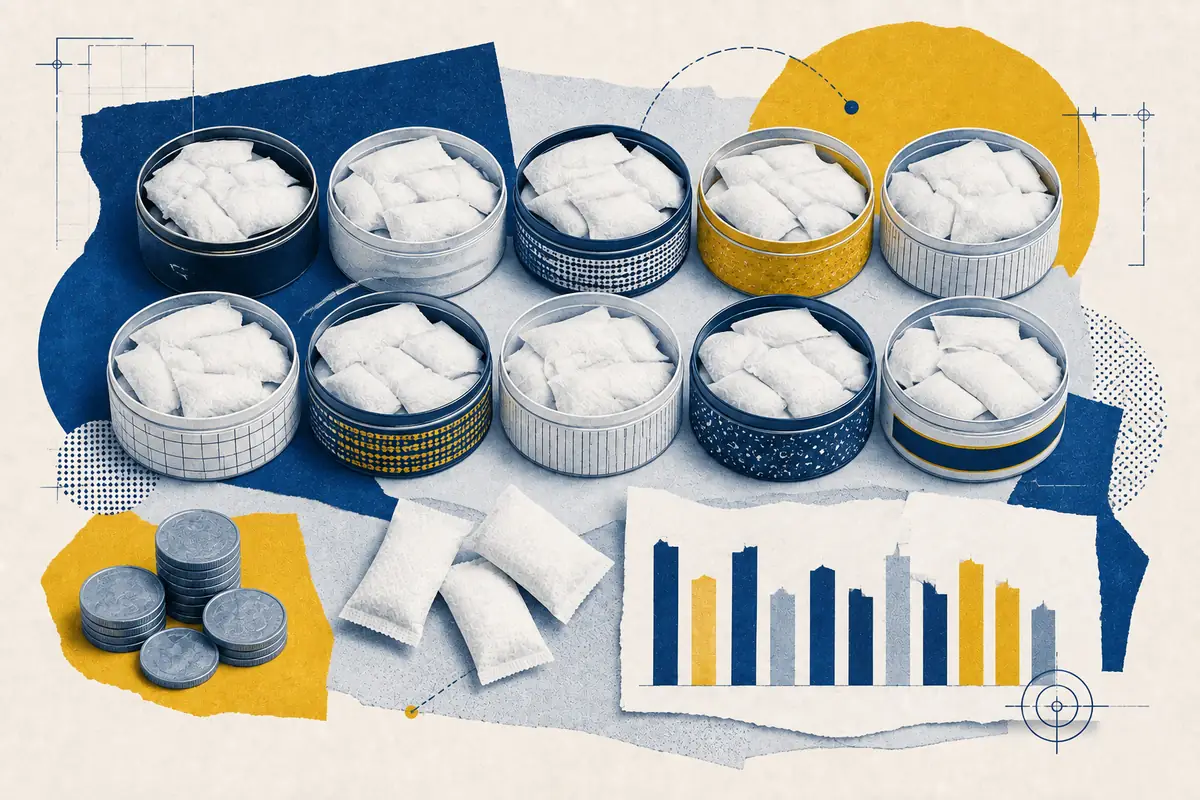
In a fixed 6 September 2026 catalogue sample, median listed price ranged from €0.2186 per pouch for Lundgrens to €0.2945 for ZONE. That is a difference of €0.0759 per pouch, or about 35% relative to the lower median. The result compares brands within one retail setting. It does not establish a universal brand price because taxes, discounts, pack formats and retailer margins can change the amount paid.
Document typeData Report
Length1,383 words
Original measurement
What the dataset records
Version 2.0.0 · Observed 06 September 2026
Median, minimum and maximum single-can EUR price per pouch by brand, calculated from 168 listings in one fixed catalogue snapshot. The common retailer is a sampling control, not the subject of the comparison.
Brand-level unit-price results
| Brand | Listings | Minimum | Median | Maximum |
|---|---|---|---|---|
| ACE | 8 | €0.2580 | €0.2580 | €0.2867 |
| Après | 18 | €0.2445 | €0.2445 | €0.2445 |
| FIX | 3 | €0.2345 | €0.2345 | €0.2345 |
| Kelly White | 9 | €0.2245 | €0.2245 | €0.2245 |
| Loop | 35 | €0.2095 | €0.2395 | €0.3193 |
| Lundgrens | 14 | €0.2090 | €0.2186 | €0.2186 |
| VELO | 37 | €0.2195 | €0.2695 | €0.3095 |
| XQS | 27 | €0.2495 | €0.2495 | €0.2495 |
| ZONE | 13 | €0.2945 | €0.2945 | €0.2945 |
| ZONE X | 4 | €0.2345 | €0.2345 | €0.2495 |
Figures are listed EUR per pouch. They are catalogue observations, not recommended retail prices or final delivered costs.
SourceCommon catalogue source for all compared brands
Source SHA-256be9b3dc568198effaba285d89a198899eca5a896de4e8c1116f18fead2843ce0
Key Findings
- Ten brands and 168 product listings were included in the same retailer and date snapshot.
- Brand medians ranged from €0.2186 per pouch for Lundgrens to €0.2945 for ZONE.
- Loop and VELO showed the widest within-brand price ranges, while several brands had one repeated unit price across all sampled products.
- Price per pouch helps normalize different can sizes, but it excludes delivery, tax, discounts and product suitability.
How were brands compared?
Each listing was assigned to the published vendor field. The listed single-can EUR price was divided by the stated number of pouches, after which the median, minimum and maximum were calculated for each brand. All ten observed brands were retained, including FIX with three products.
Using one retailer at one time holds the storefront, currency and general pricing environment constant. That makes differences within the sample easier to interpret, but it does not show what every retailer charges for the same brands.
Which brand differences are most useful to shoppers?
The lowest observed brand median was €0.2186 per pouch for Lundgrens. Kelly White followed at €0.2245. The highest median was €0.2945 for ZONE, followed by VELO at €0.2695 and ACE at €0.2580.
A brand median is a summary of sampled products, not the price of every product from that brand. The table therefore shows the number of listings and the within-brand range alongside the median.
Why does the brand median differ from the cheapest product?
The cheapest observed product answers a narrow question about one listing. The brand median places all sampled products from that brand in order and takes the middle value. It therefore describes the centre of the brand sample without allowing one unusually cheap product to define the whole brand.
The distinction matters most for Loop and VELO, where the observed ranges were wider than for brands with a single repeated price. A shopper who sees one low-priced Loop or VELO product should not assume that every flavour, format or can from that brand has the same unit price.
The table publishes the listing count, minimum, median and maximum together. Small groups deserve extra care. FIX, for example, had only three observed products, so its median is less stable than the median for VELO, which had 37.
How large was the observed brand gap?
The difference between the lowest and highest brand medians was €0.0759 per pouch. Relative to the lower median, the higher figure was about 35% greater. At twenty pouches, the arithmetic difference would be about €1.52 before any other charge.
That comparison is descriptive. It does not show that one manufacturer set a higher wholesale price or earned a larger margin. Retail pricing can reflect promotions, inventory, distributor terms, market positioning and package format, none of which were separately observed.
It also does not show what a buyer usually pays. Every listing receives equal weight because transaction volumes are unavailable. A frequently purchased product and a rarely purchased product have the same influence on their brand summary.
Why calculate price per pouch instead of price per can?
Can prices are not directly comparable when package counts differ. The sample contained 15, 18, 20 and 21 pouch cans. Dividing the listed price by the stated count puts each observation on the same physical-unit basis.
Price per pouch remains a limited measure. It does not account for nicotine content, release, product quality or suitability. Calculating price per milligram could make higher-strength products appear to offer better value, which would be an inappropriate purchasing signal for an addictive product.
The most useful display is therefore layered: can price, pouch count and price per pouch should appear together. The brand summary helps a reader notice broad differences, while the product table shows the actual offer behind each calculation.
Which costs can change the ranking for a buyer?
Shipping, tax, customs charges, currency conversion and payment fees can exceed the observed difference between brand medians. A brand with a lower catalogue unit price may not produce the cheaper delivered basket in a particular country.
Bulk tiers, subscriptions, coupons and mixed-brand offers can also change the result. This comparison uses one-can prices so that every product follows the same purchasing rule. It should not be applied to a larger basket without recalculating that basket.
Availability matters as well. A displayed price for an unavailable product is useful for catalogue analysis but cannot be treated as an offer a shopper could complete at the observation time. The row-level observations retain availability so a reader can perform a stock-only calculation.
How should a shopper navigate a brand price comparison?
Start with the brand median to see the broad position of a brand in this sample, then inspect its minimum and maximum. A narrow range suggests that sampled variants shared a common price. A wide range signals that format or product choice may matter more than the brand name alone.
Next, compare the exact products on pouch count, stated nicotine unit, package format and market version. Check the current basket total after delivery and tax. The published snapshot is useful for orientation, but a live purchase decision needs the current offer.
Price should remain separate from health and legal questions. A lower figure does not establish quality, authenticity, authorization or suitability, and it does not show that an order is permitted in the destination country.
What would make the comparison market-wide?
A broader study would collect matched products from several retailers during the same time window. It would fix destination, currency treatment, tax status, quantity and discount rules before collecting prices.
Exact product matching is essential. Brand name alone is insufficient because flavour, strength, pouch count and market version can differ. Each unmatched product and unavailable offer should remain visible instead of being silently discarded.
The present report does not make that market-wide claim. Its value is the controlled brand comparison within one published snapshot. Later versions can add retailers while keeping the same brand-level measures and showing whether the ordering changes.
Frequently Asked Questions
1. Does the lowest median identify the best brand?
No. Price per pouch does not measure product quality, nicotine delivery, authorization, freshness or individual suitability.
2. Why compare brands within one retailer?
It holds the seller, currency and observation date constant. The tradeoff is that the result cannot establish each brand’s price across the whole market.
3. Why use the median instead of the average?
The median is less affected by a few unusually high or low listings and represents the middle sampled product for each brand.
4. Are shipping, tax and discounts included?
No. The comparison uses listed single-can prices. A buyer’s final cost depends on destination, order size and available offers.
5. Can two products from the same brand have different prices per pouch?
Yes. Can price, pouch count, format and promotional treatment can differ. The minimum and maximum columns show the observed within-brand range.
6. Why is a twenty-pouch example used?
Twenty pouches was the most common package count in the sample. It illustrates the arithmetic difference but is not a claim that every can contains twenty pouches.
7. Does a higher price mean higher quality?
No. The dataset measures listed price and pouch count only. It does not test manufacturing quality, freshness, authenticity or nicotine delivery.
8. Can the brand order change at another retailer?
Yes. Retailer margins, stock, promotions and market versions can change both the prices and the ranking.
9. How can the figures be checked?
The brand summary and product observations are downloadable. Each brand statistic can be recalculated from the listed price divided by the stated pouch count for its sampled products.
Primary and authoritative sources
Source trail
- [1]
- [2]European UnionPricing and payments in the EU
- [3]European UnionShipping, delivery and total-price rights
- [4]UK Committee on ToxicityStatement on the toxicological risks of oral nicotine pouches