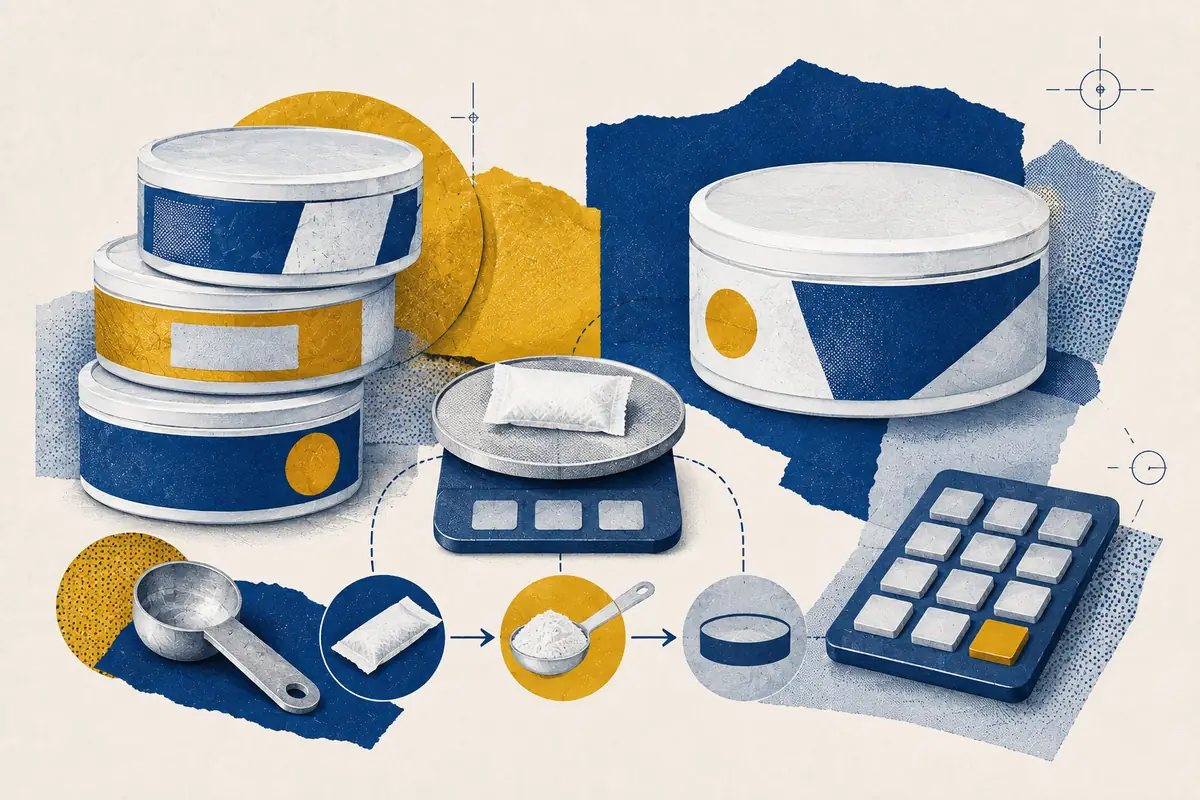
Adults comparing nicotine-pouch labels should first find the milligrams of nicotine in one pouch. If only milligrams per gram are shown, multiply that concentration by the weight of one pouch. Then check pouch count, product weight and whether the number describes content rather than nicotine released or absorbed. Descriptive strength tiers cannot be reliably compared across brands.
Document typeConsumer Guide
Length1,769 words
Key Findings
- Milligrams per pouch is the clearest nominal unit-content figure for comparing individual portions.
- Milligrams per gram is a concentration; it must be combined with the weight of one pouch to calculate nominal milligrams per pouch.
- Content, released nicotine and absorbed nicotine are related but different measurements.
- Words, dots, flames and numbered strength scales have no dependable cross-brand conversion unless the publisher defines and substantiates them.
What is the first number to look for?
Look for nicotine stated in milligrams per pouch or per portion. This is the nominal quantity assigned to the single unit placed under the lip. It is generally easier to compare than concentration because the reader does not need to know the pouch’s mass before interpreting the number.
Confirm that the denominator is explicit. A product title saying only “8 mg” may mean per pouch, per gram or another manufacturer convention. The package or structured product specification should settle the question; an unexplained retailer title should not be treated as definitive.
How is milligrams per gram converted to milligrams per pouch?
Use the formula: nicotine in mg/g multiplied by the weight of one pouch in grams equals nominal mg per pouch. For example, 16 mg/g multiplied by a 0.5 g pouch equals 8 mg per pouch. If the can weighs 10 g and contains 20 equal portions, each portion weighs 0.5 g.
Only calculate when both source values are available and use compatible definitions. Do not assume every pouch in a can has exactly the average weight, and do not present a calculated figure as a laboratory result. Keep the original values visible so another reader can reproduce the arithmetic.
Which label fields belong together?
A useful comparison record contains at least five fields: nicotine per pouch, nicotine per gram, the weight of one pouch, portions per container and net product weight. Together they allow basic arithmetic checks and reveal whether two apparently similar cans contain products of different size or concentration.
The figures should reconcile within reasonable rounding. If a can contains 20 equal pouches and 10 g net product, the implied average pouch weight is 0.5 g. A listing of 16 mg/g then implies 8 mg per pouch. If the page instead claims 16 mg per pouch, the values conflict unless another weight or definition explains the difference.
Record the market and source date as well. A brand can sell different formulations or labels under similar names in different countries, and retailers may retain old images after a change. Product identity is more precise than brand identity.
What is the difference between content, release and absorption?
Content is the nicotine present in the unused product. Released nicotine is the amount that leaves the pouch during a defined use period. Absorbed nicotine is the portion entering the body. Blood concentration measurements then describe systemic exposure over time. These measures form a chain, but one cannot be substituted for another.
A package normally reports content because it is stable enough to specify and test. Release depends on formulation and test conditions. Absorption additionally depends on pH, contact time, saliva and the user. A pouch containing 8 mg does not mean that 8 mg will be absorbed, nor that it will reproduce the exposure from an 8 mg gum or another 8 mg pouch.
This is why the guide uses “nominal” before milligrams per pouch. The word is not a suggestion that the label is false; it identifies which stage of the exposure chain the number describes. Claims about speed, intensity or equivalence require product-specific evidence beyond the content declaration.
Why are descriptive strength scales unreliable across brands?
A brand may arrange its own products as mild, regular, strong and extra strong, or display one to five dots. That can help compare products within the same defined system. It does not create a standard unit. Another brand can apply the same word or number to a different nicotine content, formulation or sensory intensity.
Some scales blend nicotine with flavour sensation. Menthol cooling, moisture and rapid release can make a product feel more intense without proving a higher nominal content. Conversely, a dry or slower-release product with a larger printed number may feel less immediate. Subjective strength and analytical content should remain separate fields.
Retail filters can worsen the ambiguity by mapping several brands into one house scale without publishing thresholds. A responsible catalogue shows numeric content first and explains any secondary categories. If the method cannot be found, use the symbols only as marketing descriptors.
How can adults compare two labels step by step?
First, verify the exact product name, market and current package. Second, find an explicit milligrams-per-pouch value. If it is absent, find milligrams per gram and pouch weight and show the conversion. Third, check portions and net weight for internal consistency. Fourth, separate measured or declared content from any claim about release, absorption or effect.
Next, note whether information comes from the package, manufacturer, retailer or an independent test. A package declaration is direct evidence of what the manufacturer states; it is not independent laboratory verification. A retailer title is convenient but can be truncated or stale. Preserve the strongest available source and flag disagreement instead of choosing the most convenient number.
Finally, compare legal eligibility separately. A numerically clear product can still exceed a destination limit, use a restricted flavour or be unavailable through a particular import route. Strength comparison is one consumer-information task, not a complete legality determination.
What are common comparison mistakes?
The most common mistake is placing mg/g beside mg/pouch as if both were unit doses. The second is converting concentration without a verified pouch weight. The third is assuming that the net weight includes only pouch contents in exactly equal portions. Each error can produce a confident-looking but unsupported comparison.
Another mistake is ranking by the largest number while ignoring the denominator. A “20 mg” headline may be less concentrated or contain less per pouch than another product depending on the missing unit. Likewise, “2% nicotine” needs a defined mass basis before it can be compared with milligrams.
Do not use the strongest available product as a benchmark for what an adult “needs.” Tolerance, dependence and health circumstances differ, and higher content can increase unpleasant or harmful exposure. This guide explains labels; it does not recommend an individual dose or encourage escalation.
What should retailers publish in structured form?
Retailers should place per-pouch and per-gram values in separate machine-readable fields, alongside unit weight, portions, net weight, market version and the date the package information was checked. The denominator should appear beside every number in lists, filters, comparison tables and structured data, not only in body copy.
Validation can automatically flag impossible or inconsistent combinations. Where values are missing, the page should say “not stated” rather than zero or infer a figure from the brand’s strength tier. Corrections should update the visible listing and retain an audit record of the source used.
A useful product-field audit would measure whether titles, product pages and package images expose the same nicotine value and denominator. It should publish missing and conflicting fields before making any cross-retailer comparison.
What should a future independent label audit test?
An audit should define a market and sampling frame, capture current package images, and record every field using a public codebook. It should distinguish manufacturer-declared values from retailer transcription and laboratory measurements, then publish row-level observations and reasons for exclusion.
Useful outcomes include the proportion of products with explicit per-pouch and per-gram values, arithmetic consistency, agreement between package and web listing, and the frequency of undefined strength symbols. Results should be reported by field rather than compressed into an opaque trust score.
A cross-retailer study must apply the same collection window and rules to every merchant. Commercial relationships, affiliate links, product samples and correction requests belong beside the result. Reproducibility is especially important when the publisher has a financial interest in one of the catalogues being assessed.
Frequently Asked Questions
1. Is 20 mg/g the same as 20 mg per pouch?
No. A 0.5 g pouch at 20 mg/g contains a nominal 10 mg; a 0.7 g pouch contains 14 mg. Pouch weight is required for conversion.
2. Do more strength dots always mean more nicotine?
They may indicate a brand’s internal ordering, but there is no dependable cross-brand scale. Compare defined numeric values instead.
3. Does the printed amount equal the dose absorbed?
No. It describes product content. Release and absorption vary with formulation, pH, moisture, contact time and individual use.
4. What if a retailer and package show different values?
Treat the conflict as unresolved. Check the unit, current package, manufacturer information and market version, and ask the retailer to correct or explain the listing before relying on it.
5. How do I calculate pouch weight when only net weight and count are shown?
Divide net product weight by the number of equal portions. For example, 10 g divided by 20 pouches gives an average 0.5 g per pouch. Confirm that the stated net weight uses the same product basis.
6. What does 2% nicotine mean?
A percentage is a concentration expression, but the mass basis and product weight must be clear before converting it to milligrams per pouch. Prefer an explicit mg/g and mg/pouch declaration.
7. Can flavour make a pouch feel stronger?
Cooling, irritation, moisture and release profile can influence subjective intensity. That feeling does not by itself establish higher nicotine content or absorption.
8. Should missing strength be treated as zero?
Never. Missing means the source did not provide a usable value. Treating it as zero corrupts comparisons and summary statistics.
9. Does this guide identify a safe nicotine level?
No. It explains how to interpret product information. A legal ceiling or clear label is not an individualized safety recommendation.
Primary and authoritative sources
Source trail
- [1]UK Committee on ToxicityStatement on the toxicological risks of oral nicotine pouches
- [2]US Centers for Disease Control and PreventionNicotine pouches: product, use and health effects
- [3]
- [4]
- [5]Danish Ministry of the Interior and HealthExecutive Order No. 249 of 4 March 2025 on nicotine-content limits