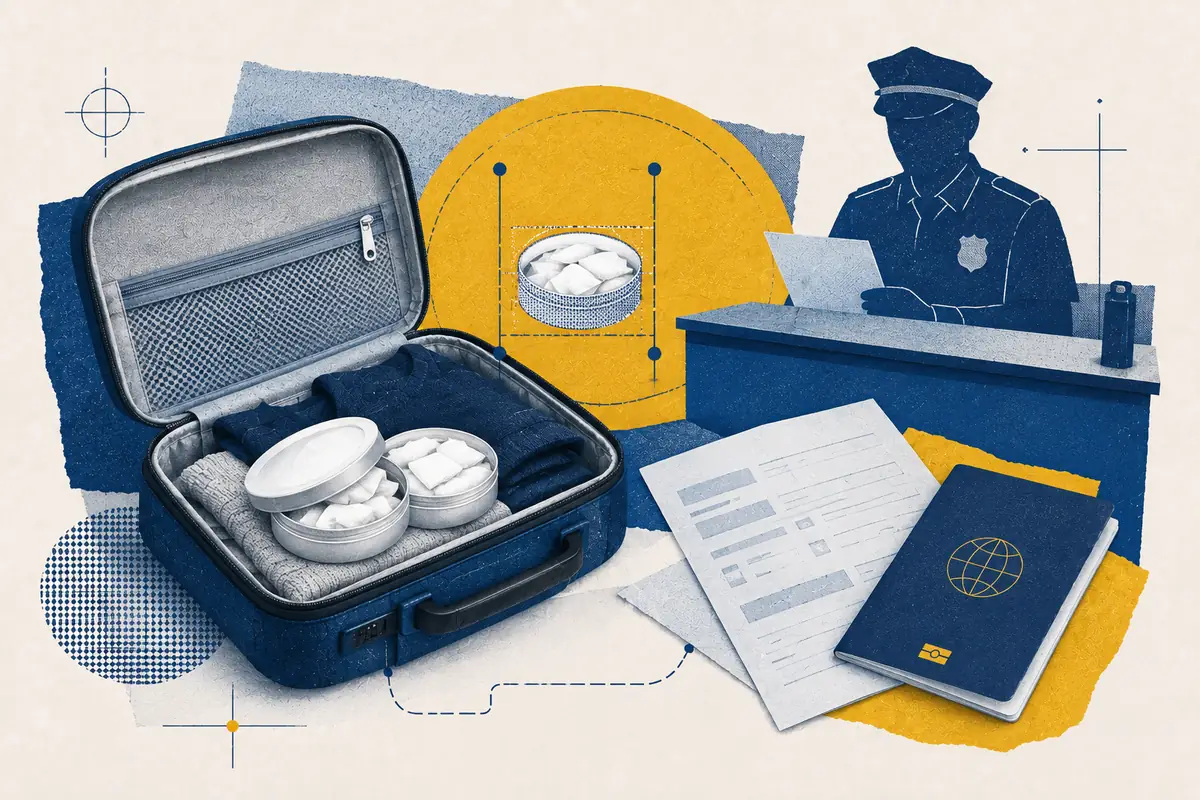
Traveller import is not the same as postal import. The traveller accompanies the goods, can be questioned about purpose and quantity, and may use baggage declaration procedures or a specific personal allowance. Whether pouches may enter still depends on the destination’s product classification, origin, traveller age, quantity, personal-use evidence, tax and any prohibition. Generic tobacco allowances should not be applied to tobacco-free pouches without an official rule doing so.
Document typePolicy Explainer
Length1,428 words
Key Findings
- Accompanied baggage and parcels use different customs processes and may have different exemptions.
- Personal allowance, permission to import and exemption from tax are not synonymous.
- Tobacco-free pouches should not be counted against tobacco allowances unless the destination rule classifies them that way.
- Original packaging, receipts, quantity and purpose help evidence personal use but cannot override a prohibition.
What makes goods “accompanied”?
The traveller transports the goods in baggage while crossing the border rather than receiving a separately shipped consignment. Customs can assess the traveller, goods, journey and declared purpose together.
Postal and courier imports involve carriers, electronic declarations and remote recipients. A traveller exception written for accompanied baggage should not be extended to mail by analogy.
What is the difference between an allowance and legality?
An allowance commonly determines how much qualifying goods can enter without tax or a full declaration. It does not transform banned or restricted goods into permitted goods.
A product can be permitted but taxable above a value threshold, permitted only within a quantity, restricted to licensed medicine, or prohibited regardless of duty. Those outcomes must be recorded separately.
Why does accompanied baggage receive a separate procedure?
The traveller and goods arrive together, allowing customs to ask where products were acquired, who will use them, how long the trip lasts and whether the quantity appears commercial. A parcel declaration usually reaches authorities through a carrier without the same immediate context.
Passenger channels and online pre-declaration services simplify low-value personal goods. Those procedural conveniences do not expand which products are allowed; banned and restricted goods still require their own authority.
A rule expressly limited to goods carried by the traveller cannot be used for a shipment arriving days later. The delivery mechanism is part of the legal fact pattern, not an administrative detail.
What are the three separate border questions?
First: may this product be imported at all? Second: does a licence, prescription, age or quantity condition apply? Third: must the traveller declare and pay tax or duty? A “yes” at one stage does not answer the others.
Personal allowances primarily address simplified tax treatment. Product prohibitions address admissibility. Medicine rules can authorize a defined patient supply. Conflating these functions produces statements such as “duty free means legal,” which is false.
Customs guidance often has a residual category for other goods based on value. A pouch should be placed there only when the destination has not assigned it to a special nicotine, tobacco, medicine or prohibited category.
Why are tobacco allowances dangerous proxies?
Cigarette, cigar and tobacco-weight allowances are usually drafted around tobacco products. Nicotine pouches contain no tobacco leaf, so applying a 250 g tobacco allowance to them requires explicit legal support rather than similarity of use.
A jurisdiction can deliberately define tobacco products to include nicotine from any source or create an oral-nicotine allowance. Another may classify pouches as other goods or medicines. The local definition controls.
The same warning applies to snus. Snus is an oral tobacco product, and a traveller rule naming snus does not necessarily include tobacco-free pouches. Search snippets and customs summaries can blur the terms.
How is personal use distinguished from commercial purpose?
Quantity is important but not exclusive. Frequency of travel, variety, packaging, receipts, communications, payment by others and intention to resell or distribute can all inform purpose.
Gifts may be permitted under some general allowances yet count differently under a nicotine-specific personal-use exception. Carrying products for several friends can therefore weaken an assertion that the goods are solely for the traveller.
There is no universal number of cans that proves personal use. A source must identify the destination’s threshold or explain that customs uses a facts-and-circumstances test.
What documentation can help?
Keep products sealed in original market packaging with ingredient, nicotine-strength, manufacturer and batch information visible. Retain the purchase receipt and any prescription or product licence relevant to a therapeutic pouch.
Documents help officials identify goods and evaluate declared value and purpose. They do not cure a product ban, excess quantity or missing authorization, and repackaging into unlabelled containers can make identification harder.
Where guidance is ambiguous, obtain a written answer from customs or the competent product regulator before travel. Record the exact product, strength, quantity, origin, route and date in the question.
What does UK passenger guidance demonstrate?
UK guidance illustrates the general border architecture: personal goods can be within allowances, goods over allowances or otherwise declarable must be declared, and banned or restricted goods remain subject to separate controls. Commercial goods have no personal allowance.
The guidance publishes tobacco and vaping allowances and a residual allowance for other goods. It does not, on the cited page, create a specifically named nicotine-pouch allowance. The report therefore does not invent one.
A traveller to Great Britain should check current product status and use the customs declaration service when required. Northern Ireland can have different arrangements, another reason that “UK border” is sometimes too coarse a geography.
How do therapeutic pouches complicate travel?
A pouch licensed as nicotine-replacement therapy can be a health product in the destination. Personal medication rules may consider dosage, prescription status, resident or visitor status, labelling and length of treatment.
Health Canada’s general personal-import guidance discusses personal quantities and stricter conditions for prescription drugs. That framework must be applied to the exact pouch status; it is not permission for all foreign consumer brands.
Travellers should carry the licensed product record or prescription where applicable and avoid substituting a similar-looking high-strength consumer pouch. Regulatory equivalence follows authorization, not format.
What should a traveller check before departure?
Check the origin, destination, accompanied-baggage route, traveller age, product classification, maximum quantity or value, declaration duty, tax treatment and date of the rule. An unanswered variable should remain unknown rather than be inferred.
Do not substitute postal-import guidance for traveller rules. A country may allow a small accompanied quantity while banning distance acquisition, or permit licensed postal medicines under conditions while restricting consumer baggage.
Consult the destination customs authority and product regulator. A retailer can identify the product and transaction, but it cannot provide the legal authority for crossing a border.
Allowances, classifications and commencement dates change. The relevant rule is the one applying on the arrival date, not necessarily the rule visible when the trip was booked.
Check whether the allowance changes with the country of departure. Customs unions, neighbouring territories and duty-free zones can produce different tax or declaration treatment even when the destination is the same.
Frequently Asked Questions
1. Do cigarette allowances apply to nicotine pouches?
Do not assume so. Tobacco-free pouches may fall under another-goods, nicotine-product or prohibited-goods rules depending on the destination.
2. Does duty-free purchase guarantee entry?
No. Duty-free describes the sale or tax treatment at departure; destination restrictions and declaration duties still apply.
3. Should a traveller keep products in original packaging?
Yes, because identity, strength, quantity and personal-use purpose are easier to assess, but packaging does not create a legal exemption.
4. What should a traveller do when official guidance is unclear?
Contact the destination customs or product regulator before travel and retain the response; do not rely on a retailer or forum anecdote.
5. Can used or opened cans count toward a limit?
They may. Quantity rules can cover all goods carried, not only sealed retail units; check the exact wording.
6. Does transit through a country count as import?
Transit regimes vary. Remaining airside may differ from clearing customs or reclaiming baggage, so the route must be checked.
7. Can customs seize undeclared pouches?
Potentially, where goods are prohibited, restricted or should have been declared. Consequences depend on destination law and facts.
8. Are traveller allowances shared between passengers?
Often no. UK guidance, for example, states that personal allowances cannot be combined, but the destination’s exact rules control.
Primary and authoritative sources
Source trail
- [1]UK GovernmentBringing goods into the UK for personal use
- [2]UK GovernmentWhen travellers must declare goods to customs
- [3]Health CanadaPersonal-use import guidance for health products
- [4]World Health OrganizationExposing marketing tactics driving global pouch growth
- [5]European UnionGeneral Product Safety Regulation (EU) 2023/988