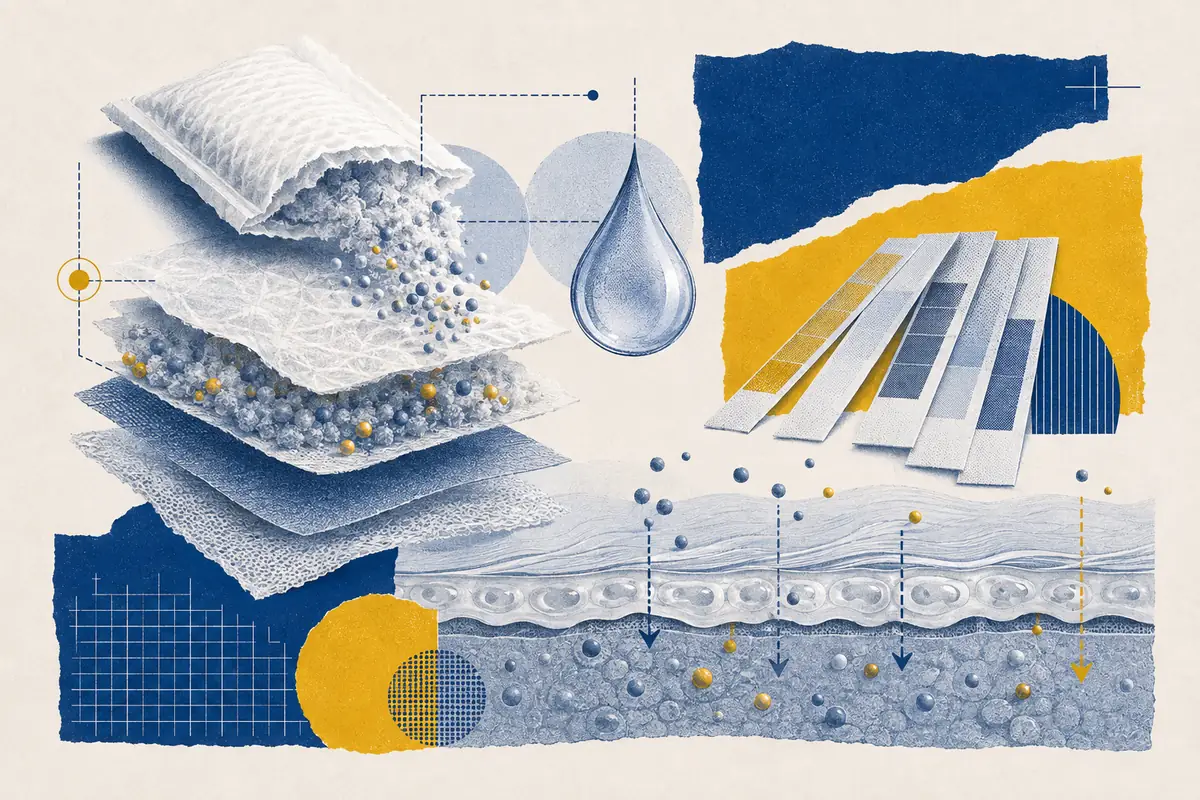
Nicotine delivery is a sequence, not a label number. The pouch must wet, nicotine must dissolve and be released, and a fraction must cross the oral lining. Higher pH generally increases the unprotonated nicotine available for mucosal transfer, while moisture and formulation affect release, but no single variable reliably predicts a person’s absorbed dose or experience.
Document typeExplainer
Length1,461 words
Key Findings
- Nominal nicotine content, released nicotine and absorbed nicotine are distinct measurements.
- pH changes the balance between protonated and unprotonated nicotine and can influence oral uptake.
- Moisture, particle structure, salts, pouch material and use duration can alter the release curve.
- Products with the same milligrams per pouch can produce different concentration-time profiles.
What happens between opening a can and nicotine reaching blood?
Saliva enters the pouch, dissolves soluble constituents and carries nicotine to the oral surface. Nicotine then crosses the mucosa; some may instead be swallowed and processed through the gastrointestinal tract and liver.
Each stage has its own measurement: content inside the unused pouch, amount extracted during use, amount absorbed systemically, peak blood concentration and time to that peak. Treating them as one number obscures the mechanism.
Why does pH affect oral uptake?
Nicotine can exist in charged, protonated form and uncharged, unprotonated form. The balance changes with pH. More alkaline conditions generally increase the unprotonated fraction that crosses biological membranes more readily.
That does not make pH an independent dose meter. Buffer capacity, saliva, nicotine salt, contact area and time interact, and laboratory extract pH may not reproduce conditions at the gum during real use.
How does pH change nicotine form?
Nicotine is a weak base. In a more acidic environment a greater share is protonated and charged; as conditions become more alkaline, the unprotonated share rises. The uncharged form generally crosses oral membranes more readily.
Manufacturers can use carbonate or bicarbonate salts and other buffers to influence pH. The effect depends not only on an initial pH reading but on buffer capacity, how strongly the product maintains conditions as saliva enters.
A laboratory may report the pH of an aqueous extract. That standardized result helps compare products but is not a continuous measurement at a user’s gum. Saliva composition, flow and product placement alter the microenvironment during use.
Higher pH can therefore support faster permeation, yet it is not a standalone prediction. Total nicotine, surface area, dissolution, contact time and formulation all determine how much nicotine is available at the membrane.
What does moisture change?
Water already present in a pouch can begin dissolving ingredients quickly after placement. Drier products rely more on saliva entering the material before soluble nicotine becomes mobile. That can change the early release curve and sensory onset.
Moisture also affects softness, swelling, drip and flavour release. A moist product may create a faster initial experience, but “moist” is not a calibrated pharmacokinetic category and cannot be ranked without measurement.
Physical-characterization research has found wide product differences in moisture, water activity, solubility and pH. Those variables do not always move together, showing why one design label cannot stand in for the formulation.
Storage matters. A package that loses water or takes it up can change texture and possibly dissolution. Shelf-life testing and sealed packaging are therefore part of product consistency rather than mere convenience.
How do salts, particles and the pouch material matter?
Nicotine may be present as a salt or free base, embedded in cellulose or other carrier material. Salt choice and particle structure affect solubility, while fillers and binders influence how water moves through the contents.
The outer non-woven pouch must admit saliva and allow dissolved compounds to leave while retaining solids. Fibre density, seam, dimensions and fill distribution can change contact area and flow. Those features are rarely captured by a strength label.
Laboratory dissolution tests can hold agitation, fluid and temperature constant to compare release. Buccal-permeation models add a membrane barrier. Neither perfectly reproduces a living mouth, but together they reveal mechanisms that a content assay cannot.
A product can release a high proportion of its nicotine without producing the fastest peak if permeation or use time differs. Release percentage, release rate and systemic uptake should remain separate outcome fields.
What role do flavour and cooling sensations play?
Mint, menthol and synthetic cooling agents can create sensations that users interpret as strength. Irritation or tingling can also arise from alkalinity and nicotine. Perceived intensity is therefore a mixture of sensory and pharmacological signals.
A stronger sensation does not prove a higher absorbed dose, and a smooth sensation does not prove a lower one. Blinded pharmacokinetic testing is needed when comparing delivery rather than consumer expectation.
Flavour can affect how long someone keeps a pouch in place, how frequently it is used and whether saliva is swallowed. Those behavioural effects may matter as much as direct chemical effects on release.
Studies should identify flavour and cooling formulation because two otherwise similar products may not be experientially matched. Consumer guides should keep flavour preference separate from nicotine-strength advice.
Why does use duration not scale exposure perfectly?
Nicotine release is usually not constant minute by minute. A larger fraction may leave early, followed by a slower tail as readily soluble material is depleted. Doubling wear time therefore need not double extraction or blood concentration.
Recent duration studies measure residual pouch nicotine alongside plasma concentration to connect product loss with systemic exposure. The relationship still varies by formulation and participant, reinforcing that a universal “minutes equals dose” rule is not justified.
Longer contact can also extend local exposure and irritation even when systemic uptake is flattening. The endpoint of interest, peak concentration, total exposure or oral contact, changes how duration should be interpreted.
Manufacturer directions provide a product-specific use context, not a promise of absorbed dose. Using multiple pouches or combining pouches with smoking, vaping or medicines changes the exposure question entirely.
How should products be compared responsibly?
Begin with milligrams per pouch and pouch mass, then add pH method, moisture, free-nicotine fraction, dissolution profile, use duration and pharmacokinetic results. Record the exact product and market because names can cover different formulations.
Compare like with like. A blood-concentration study in experienced nicotine users does not directly predict effects in nicotine-naive people, and an in-vitro membrane model does not establish dependence or clinical outcomes.
Where only label data exist, the conclusion must remain limited to content. Retailers can help by separating per-pouch content from per-gram concentration and avoiding claims such as “fast acting” unless the manufacturer supplies a clear basis.
For adult consumers, lower familiar strength and avoidance of concurrent nicotine reduce the risk of unexpectedly high exposure, but individualized dosing advice belongs with a qualified clinician, especially during pregnancy, with cardiovascular disease or when using cessation medicines.
Frequently Asked Questions
1. Does a higher-pH pouch always deliver more nicotine?
No. Higher pH can increase the readily absorbable fraction, but total content, release, buffering, duration and user factors also matter.
2. Does a moist pouch always act faster?
Moisture can accelerate initial dissolution, but formulation and pouch construction prevent a universal rule across products.
3. Is released nicotine the same as absorbed nicotine?
No. Release measures nicotine leaving the pouch; absorption measures nicotine entering the body.
4. Can two 6 mg pouches feel different?
Yes. They may differ in pH, moisture, flavour cooling, release profile, pouch geometry and individual use conditions.
5. What is free nicotine?
It is the unprotonated form of nicotine. It generally crosses membranes more readily, but the measured fraction depends on pH and the method used.
6. Why do studies report time to maximum concentration?
It describes how quickly systemic nicotine peaks. Two products can have similar total exposure but different peak timing and intensity.
7. Does swallowing saliva increase exposure?
Swallowed nicotine can be absorbed through the gastrointestinal route, but it undergoes different processing and does not make oral and buccal exposure equivalent.
8. Can a pH number be read like nicotine strength?
No. pH affects nicotine form, but it does not state total content, release or absorbed amount.
9. What would a complete product study measure?
Content, isomer and salt form, pH and buffering, moisture, dissolution, residual nicotine, buccal permeation, plasma pharmacokinetics, subjective effects and adverse events.
Primary and authoritative sources
Source trail
- [1]Nicotine & Tobacco ResearchNicotine pouch pharmacokinetics compared with smoked tobacco: systematic review and meta-analysis
- [2]Scientific ReportsRandomized pharmacokinetic comparison of a pouch, gum and lozenge
- [3]Journal of Pharmaceutical SciencesFactors affecting nicotine dissolution and buccal permeation
- [4]UK Committee on ToxicityStatement on the toxicological risks of oral nicotine pouches
- [5]PsychopharmacologyRandomized pharmacokinetic comparison of oral pouches and a cigarette
- [6]Clinical and Translational SciencePouch-use duration, extraction and plasma nicotine pharmacokinetics
- [7]Scientific ReportsDissolution and physical characterization of oral nicotine pouches
- [8]German Federal Institute for Risk AssessmentHealth risk assessment of nicotine pouches