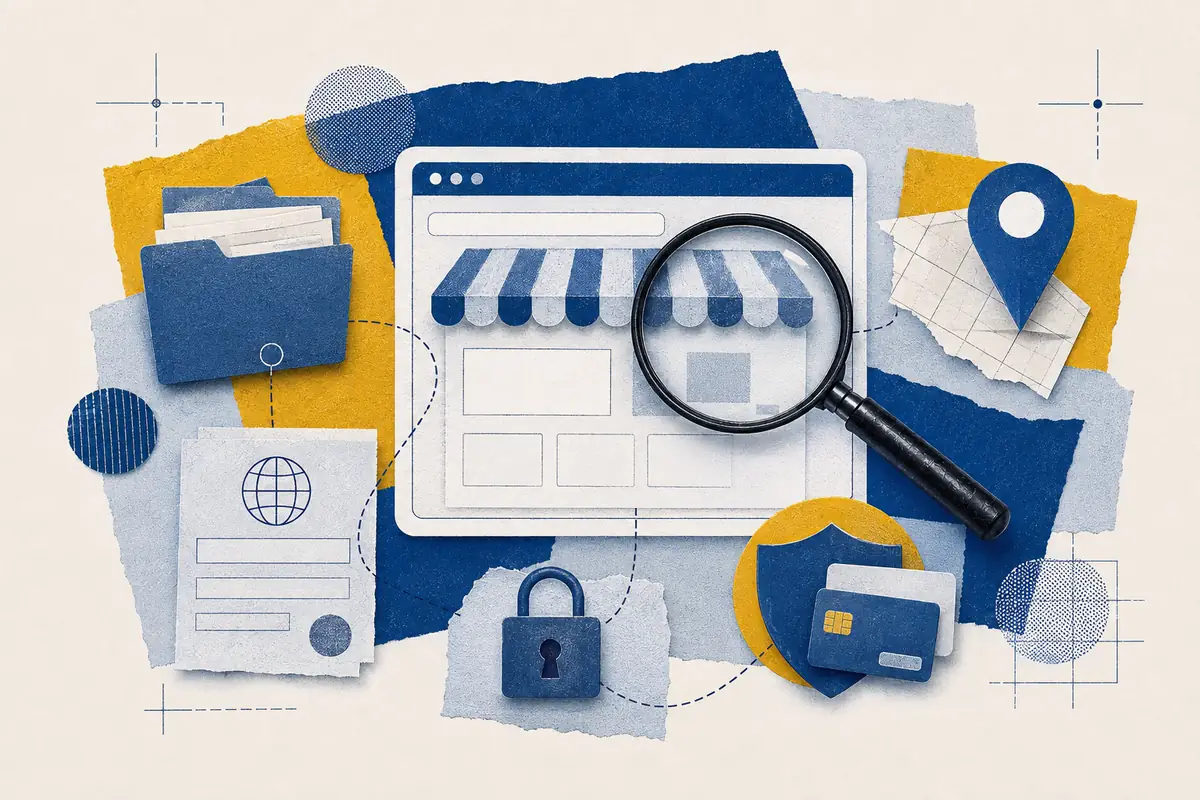
Identify the legal business name, registration number, geographical address, working contact channels and responsible operator, then match them against an official company or tax register. Check filing status, domain and payment consistency, product-market claims and independent complaint patterns. Registration proves that an entity record exists; it does not certify stock, product authorization, solvency or trustworthy conduct.
Document typeConsumer Guide
Length1,525 words
Key Findings
- The storefront name may differ from the company legally responsible for the contract.
- Official registers can verify entity status, address, officers and filing history, but not the truth of every website claim.
- Contact, returns, payment and domain details should form one coherent business identity.
- HTTPS encrypts a connection; it does not establish that the merchant is genuine or reliable.
Which identity details should appear before checkout?
Look for the trader’s legal name, geographical address, email, telephone or durable contact channel, registration and VAT details where applicable, and the identity of any business acting on another’s behalf.
The terms, privacy notice, refund policy, invoice and payment descriptor should identify the same responsible party or explain the relationship among them.
What can an official company register establish?
A register can show incorporation, status, registered office, officers, filings, former names and sometimes beneficial ownership. Search using the company number rather than accepting a linked badge.
A live registration is a necessary identity check in many cases, not an endorsement. Recently formed, dormant, overdue or mismatched entities require additional scrutiny.
How do storefront, trader and payment entity differ?
The domain and logo identify a storefront. The contract should identify the legal trader responsible for supply and consumer obligations. A payment facilitator or group company may appear on the card statement. These identities can differ legitimately, but the relationship should be documented.
Read the terms, privacy notice, invoice and payment confirmation together. If each gives a different company without explanation, the consumer may not know whom to contact, sue, report or return goods to.
A marketplace adds another layer: the platform may process payment while an independent seller fulfils the order. The product page should identify whether the consumer contracts with the platform or third-party trader.
How should a company number be checked?
Copy the number into the official register rather than following a retailer-controlled badge. Match exact name, status, jurisdiction and registered office. Review incorporation date, latest filings, overdue records, former names and relevant business activity.
Companies House makes public UK company data and filings available without charge. Its register is primary evidence of what was filed, but the service itself warns through its statutory model that company-supplied information is not equivalent to commercial due diligence.
A mismatch can be innocent, trading names and group structures are common, but it should be explainable. A number belonging to an unrelated or dissolved business is a serious warning.
What does registration fail to prove?
Registration does not prove the website is controlled by that company. Fraudsters can copy a genuine company’s name and number. Confirm that official filings, domain contact, bank recipient, email and invoice form a coherent chain.
It also does not prove inventory, product authenticity, authorization, solvency or delivery performance. A newly incorporated business can be legitimate, and a long-established entity can still provide poor service.
Treat registration as one verified fact. Combine it with product records, policy clarity, payment protection, fulfilment evidence and complaint handling rather than turning it into a trust score by itself.
Which contact tests are proportionate?
A working email on the retailer’s domain, a geographic returns address and a response to a precise pre-sale question are more useful than a form with no durable copy. Save the message and reply.
Ask who the contracting company is, where goods dispatch from, who handles returns and whether destination taxes are prepaid. Vague or contradictory answers expose operational gaps before money is committed.
Do not demand unnecessary personal documents from small retailers or publish private staff data. Verification should focus on the legal business and public commercial contact channels.
What should be checked about the domain and checkout?
HTTPS protects the connection to the current domain, but it does not authenticate the merchant’s business claims. Look for misspellings, recently changed domains, copied policy text, broken social links and redirects to unrelated payment pages.
The checkout should show item, quantity, currency, taxes, shipping, total price and trader before payment. Surprise fees, forced bank transfer or an unexplained personal account increase recovery risk.
Domain-age and reputation services are secondary signals and can be wrong or privacy-obscured. Use them to identify questions, not to declare a retailer fraudulent without stronger evidence.
How should reviews and complaints be interpreted?
Look for patterns across sources: non-delivery, counterfeit concerns, surprise customs fees, refund delay or unresponsive support. One angry or enthusiastic review is weak evidence, and platforms can contain manipulation in both directions.
Recency, detail and merchant response matter. A credible response identifies the order process without exposing customer data, explains remediation and does not threaten criticism away.
Search legal name as well as storefront name. Complaints may attach to the payment entity or former brand, while copied reviews can attach to a new domain with no genuine history.
What is a practical pre-purchase verification record?
Save the product page, basket total, shipping promise, returns terms, trader identity and contact response with timestamps. Record the official register URL and the exact company number matched.
For a nicotine product, separately capture strength, denominator, manufacturer, market version and any regulator authorization claimed. Business legitimacy and product legality are independent checks.
Use a payment method with appropriate dispute protection and avoid spending more than you can tolerate being delayed. These steps reduce uncertainty; they do not guarantee fulfilment.
How should a retailer’s own pages be used in verification?
A retailer’s contact page, policies and terms can establish what the business claims about its identity and service. They cannot independently prove that the claims are accurate or that the business is trustworthy.
Match the stated legal name, registration number and address against the appropriate official register. Compare the identity across the terms, invoice, payment descriptor and returns information, and investigate unexplained differences.
Treat endorsements, badges and prominent search placement as weaker evidence than a coherent registered identity and verifiable operating record. A retailer should pass the same checks regardless of where the reader first encountered it.
Which warning signs justify stopping the purchase?
Stop when the contracting trader cannot be identified, the company number belongs to another business, the return address is concealed, payment is redirected to an unexplained personal account, or support refuses a basic identity question. Several smaller inconsistencies can be as important as one dramatic red flag.
Pressure devices, countdowns that reset, implausible scarcity, unsolicited direct messages and prices far below the market, should trigger additional checking. They do not prove fraud, but they reduce the time a consumer is encouraged to spend verifying the transaction.
For a regulated or age-restricted product, stop when the seller promises universal legality, offers to misdeclare contents, removes manufacturer packaging or proposes evading age or customs controls. Those actions undermine both product identity and any later dispute.
Document the issue without sending more identity data. If payment was already made, use the merchant’s written complaint route and payment-provider protections promptly, retaining the original pages and correspondence.
Frequently Asked Questions
1. Does a VAT number prove the shop is trustworthy?
No. It can help verify tax identity, but it does not prove product authenticity, fulfilment or regulatory compliance.
2. Is a registered-office service a red flag?
Not by itself. Many legitimate businesses use one, but the site should still provide effective contact and returns arrangements.
3. Does HTTPS prove the business is genuine?
No. It protects data in transit to the domain; fraudulent sites can also obtain certificates.
4. What if the card statement uses another name?
The relationship should be explained in the terms or receipt. An unexplained descriptor is a reason to confirm the contracting and payment entities.
5. Should the website address match the company name?
Not necessarily; trading names differ. The terms should clearly connect the storefront with the contracting legal entity.
6. Is a social-media following evidence of legitimacy?
It is weak supporting context. Followers and engagement can be purchased, and an account does not establish the legal trader.
7. What is the strongest single check?
There is no single check. Coherent identity across official register, contract, payment, contact and fulfilment evidence is stronger than any badge.
8. Can a regulator product list verify the retailer?
No. It can verify named product authorization, not whether a particular seller is genuine or authorized to retail it.
9. Should consumers upload ID to an unknown shop?
Age assurance may be required, but the retailer should explain provider, data use, retention and security before sensitive documents are supplied.
Primary and authoritative sources
Source trail
- [1]UK GovernmentOnline and distance selling requirements
- [2]Companies HouseSearching the official UK company register
- [3]European CommissionOnline marketplace seller-identity and fee transparency
- [4]European UnionConsumer rights when shopping online in the EU
- [5]European UnionData protection and online privacy
- [6]US Food and Drug AdministrationCurrent list of authorized nicotine-pouch products