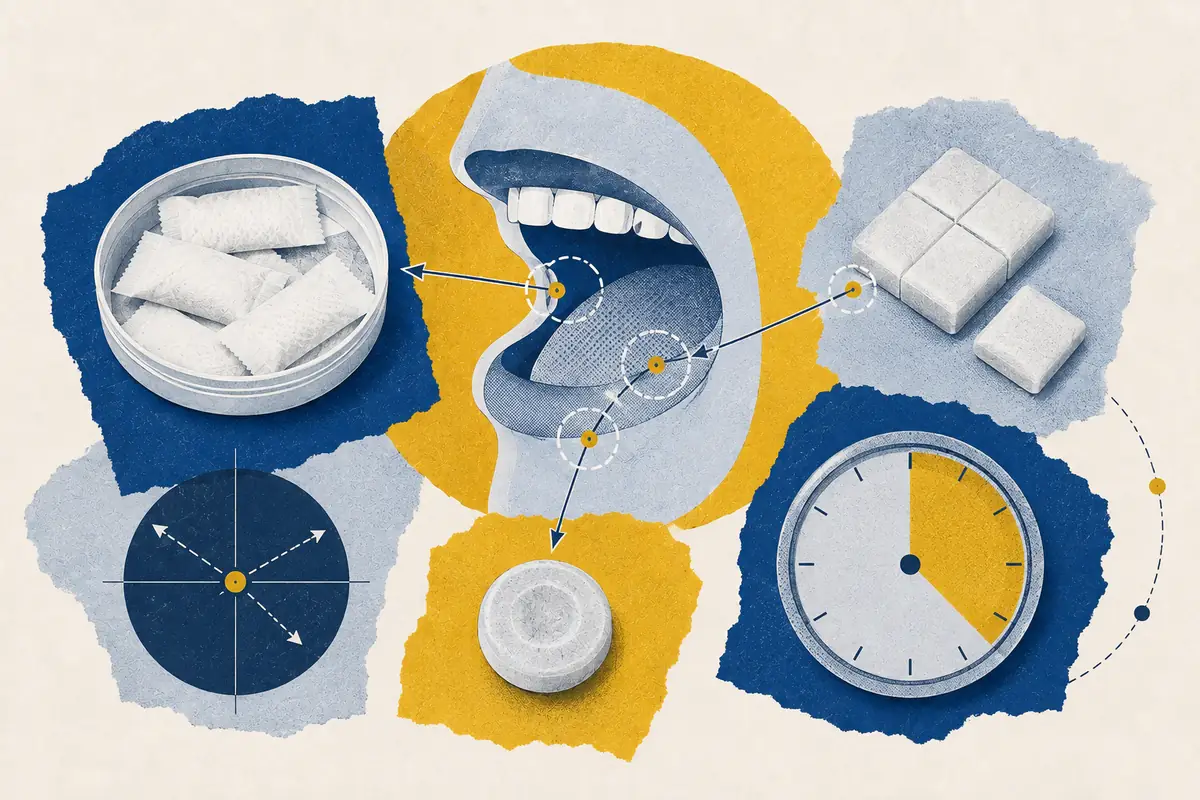
Nicotine pouches, gum and lozenges all deliver nicotine through the mouth without combustion. In the United States, gum and lozenges are regulated and labelled as smoking-cessation medicines, while consumer nicotine pouches are not FDA-approved cessation aids. Their printed milligram values are not directly interchangeable: dosage form, release, instructions and product purpose all affect exposure and use.
Document typeComparison
Length2,043 words
Key Findings
- The shared oral route does not make the products therapeutically or pharmacokinetically equivalent.
- FDA-authorized consumer pouches and FDA-approved nicotine-replacement medicines pass through different legal and evidentiary pathways.
- Nicotine gum and lozenges have standardized labelled regimens and a large cessation evidence base; modern consumer pouches do not yet have comparable cessation evidence.
- A number such as 4 mg describes nominal content in a particular dosage form, not an equal absorbed dose or equal effect across products.
What do the three products have in common?
All three avoid burning tobacco and deliver nicotine in the mouth. A pouch rests between lip and gum; a lozenge dissolves in the mouth; nicotine gum is used with a specific chew-and-park technique. Nicotine from each product can cross the oral lining, although formulation and use determine how much is released, swallowed and absorbed over time.
They can therefore overlap in the immediate experience they are intended to address, such as nicotine craving. That functional overlap is real, but it is not proof that the products have the same dose, safety instructions or demonstrated effect on quitting smoking.
What is the most important difference?
Nicotine gum and lozenges sold as nicotine-replacement therapy are medicines with a labelled therapeutic purpose: helping adults stop smoking. Their instructions connect strength and frequency to smoking history and define a step-down course. Consumer nicotine pouches are generally sold for nicotine use rather than as a time-limited treatment programme.
The US Centers for Disease Control and Prevention states that the FDA has not approved any nicotine pouch as a smoking-cessation aid. This remains true even where the FDA has authorized particular pouch products to be marketed through the tobacco-product pathway. Authorization to sell and approval to make a treatment claim answer different questions.
Why does regulatory purpose change the comparison?
A medicine is evaluated against a proposed therapeutic use. For over-the-counter nicotine gum and lozenges in the United States, the label identifies them as stop-smoking aids, defines who should use them, explains how to select a strength and supplies a multi-week schedule. The claim, dose instructions, warnings and evidence are parts of one regulated product proposition.
Consumer nicotine pouches enter through a different pathway. Some named products have FDA marketing authorization as tobacco products, but the CDC states that none is FDA-approved to help people quit smoking. That distinction controls what can responsibly be claimed: the availability of a pouch does not make it a medicine, and a population-health marketing order does not establish clinical efficacy for cessation.
Jurisdictions do not classify every oral nicotine product identically. A pouch can be treated as a tobacco-related product, a general consumer product, a prescription product or an authorized nicotine-replacement product depending on composition, claims and local law. This article uses the US medicine-versus-consumer distinction because the supporting labels are unusually explicit; it should not be read as a universal legal classification.
How are gum and lozenges meant to be used?
Nicotine gum is not used like ordinary chewing gum. Its consumer label instructs users to chew slowly until a tingling sensation appears, then park it between cheek and gum, repeating the cycle for about 30 minutes. The technique is intended to support oral absorption and reduce swallowing of nicotine, which can contribute to hiccups or stomach discomfort.
A lozenge is allowed to dissolve slowly in the mouth and is moved from side to side rather than chewed or swallowed. Labels commonly offer 2 mg and 4 mg options and use time to the first cigarette after waking as a dependence proxy for selecting an initial strength. They also provide a schedule that starts more frequently and tapers over approximately twelve weeks.
These instructions show why dosage form is part of dose. A user who chews rapidly, swallows a lozenge or eats and drinks around administration may change delivery and tolerability. Consumer pouches have their own manufacturer directions, but they do not generally reproduce the standardized cessation regimen or connect each use to a planned course toward smoking abstinence.
Why can the printed milligrams not be compared directly?
A label stating 4 mg identifies nicotine content assigned to that gum, lozenge or pouch unit. It does not promise that 4 mg reaches the bloodstream. Some nicotine remains in the product, some is swallowed, and the amount crossing the oral lining depends on pH, formulation, moisture, contact time and technique. The resulting concentration curve can differ even where nominal content matches.
This is the difference between content, release, systemic exposure and effect. Content can be measured in the product; release is what leaves it during use; systemic exposure is what reaches circulation; effect includes craving relief, adverse symptoms and reinforcement. A comparison that jumps from the first measure to the last ignores the stages that make dosage forms behave differently.
The problem is especially visible in retail listings. A pouch title may show a bare milligram number without specifying per pouch or per gram, while medicine labels state a dosage unit within detailed directions. Responsible comparison therefore begins by confirming the denominator and product label, then uses product-specific pharmacokinetic or clinical evidence rather than assuming numerical equivalence.
How strong is the smoking-cessation evidence?
The evidence base for licensed nicotine-replacement therapy is large. A Cochrane review identified 136 trials, with 64,640 participants in the main analysis, and found high-quality evidence that licensed forms of NRT increased the chances of stopping smoking by roughly 50% to 60% compared with placebo or no NRT. Those findings cover a class of regulated therapies used in people making quit attempts.
A later Cochrane review compared NRT regimens. It found high-certainty evidence that combining a patch with a fast-acting form such as gum or lozenge improves quit success compared with using one form alone, and that 4 mg gum can be more effective than 2 mg gum in the studied populations. These are treatment comparisons within NRT; they do not mean that higher nicotine content is always better or safer for every person.
The modern nicotine-pouch evidence is much thinner. The systematic reviews discussed in Report 06 found small, short and heterogeneous trials, with no statistically significant cessation benefit established. It is therefore inappropriate to transfer the NRT effect estimate to pouches merely because both contain nicotine and contact the mouth.
How do intended behaviour and product design differ?
Cessation medicines are framed around a defined goal: stop smoking, manage withdrawal and generally reduce treatment use over time. The instructions can be demanding, but they make the behavioural pathway explicit. Outcomes such as sustained abstinence can then be studied against that intended course.
Consumer pouches are typically designed for repeated, convenient nicotine use. Variety, flavour and discreet use may make them acceptable substitutes for cigarettes for some adults, but those same attributes can support long-term use or dual use. The product does not impose a quit date, a taper or a distinction between relief of withdrawal and recreational consumption.
Neither pathway describes every individual. Some adults use medicine longer than a label’s standard course, while some smokers may switch completely to pouches and later stop nicotine. The analytical point is that product architecture and marketing influence likely behaviour. A clinical outcome observed under one set of instructions should not be assumed under another.
What safety comparison can the evidence support?
All three products avoid smoke and the toxic products of combustion. That is an important distinction from cigarettes. They still deliver addictive nicotine and can produce dose-related symptoms. Gum and lozenges commonly cause local or gastrointestinal effects linked to dosage form and technique; pouches can cause oral irritation and may deliver high nicotine exposures depending on formulation.
The long clinical history and trial record for licensed NRT provide a more developed safety evidence base than exists for modern pouches. This does not prove that every gum or lozenge is appropriate for every user, nor that every pouch is more hazardous. It means confidence differs because the products, surveillance histories and studied outcomes differ.
Individual suitability can turn on cardiovascular history, pregnancy, age, current medicines and severity of dependence. Product labels and health professionals are better sources for case-specific advice than a general comparison page. People who do not use nicotine should not begin with any of these products, and accidental ingestion requires prompt poison-control or emergency advice.
What would a fair head-to-head pouch trial need to measure?
A useful trial would recruit adults who smoke and intend to quit, then compare a clearly identified pouch regimen with labelled gum or lozenge treatment under equal behavioural support. The study would need adequate power, prespecified outcomes, biochemically verified abstinence and follow-up of at least six months. Product strength, actual use and adherence would need to be recorded rather than assumed.
The trial should report more than a single quit rate. Craving, withdrawal, adverse events, dual use, continued use of the assigned product, relapse and complete nicotine abstinence answer different questions. A pouch could conceivably support cigarette abstinence while sustaining nicotine dependence; whether that is beneficial depends on the comparator and the decision being evaluated.
Funding and product supply should be transparent, and results should be published regardless of direction. Until such evidence is replicated, the defensible conclusion is asymmetric: gum and lozenges have established cessation evidence when used as regulated NRT, while nicotine pouches remain consumer products with possible substitution value but unproven cessation efficacy in the United States.
Frequently Asked Questions
1. Is a 4 mg pouch equivalent to 4 mg nicotine gum?
No. The number describes nominal nicotine content in different formulations. Release, use instructions, contact time and absorption differ, so milligram-for-milligram equivalence should not be assumed.
2. Are nicotine pouches a form of nicotine-replacement therapy?
Not automatically. In the United States, consumer nicotine pouches are not FDA-approved cessation aids. Product classification and authorization can differ in other countries.
3. Do gum and lozenges have evidence for helping people quit?
Yes. High-certainty systematic-review evidence supports licensed nicotine-replacement therapy for smoking cessation. That evidence applies to the evaluated medicines and regimens, not automatically to consumer pouches.
4. Which product should an individual use?
This comparison cannot choose treatment for an individual. A clinician, pharmacist or recognized stop-smoking service can consider dependence, medical history, pregnancy, age and previous quit attempts.
5. Why do nicotine-gum labels use time to the first morning cigarette?
It is used as a practical indicator of nicotine dependence when selecting between commonly marketed 2 mg and 4 mg starting strengths. The full label and professional advice still matter.
6. Can someone chew nicotine gum like normal gum?
No. Consumer labels describe a chew-and-park technique. Continuous rapid chewing can change delivery and increase unpleasant effects such as hiccups or stomach discomfort.
7. Does a pouch work faster than a lozenge?
That cannot be answered for the categories as a whole. Release varies by exact formulation, strength, pH and use. Product-specific pharmacokinetic evidence is required.
8. Is long-term NRT use the same as continued smoking?
No. NRT delivers nicotine without cigarette smoke. Individual duration and safety questions should be discussed with a clinician or pharmacist, but the exposures are not equivalent to combustion.
Primary and authoritative sources
Source trail
- [1]US Food and Drug AdministrationFDA-approved products that can help people stop smoking
- [2]US Centers for Disease Control and PreventionNicotine pouches: product, use and health effects
- [3]Cochrane Tobacco Addiction GroupNicotine replacement therapy versus control for smoking cessation
- [4]US National Library of Medicine, DailyMedNicotine polacrilex gum consumer label
- [5]US National Library of Medicine, DailyMedNicotine polacrilex lozenge label
- [6]Cochrane Tobacco Addiction GroupComparing ways to use nicotine replacement therapy
- [7]
- [8]Hartmann-Boyce et al., Cochrane Database of Systematic ReviewsOral nicotine pouches for cessation or reduction of other tobacco or nicotine use
- [9]US Food and Drug AdministrationScientific review and authorization of ZYN products