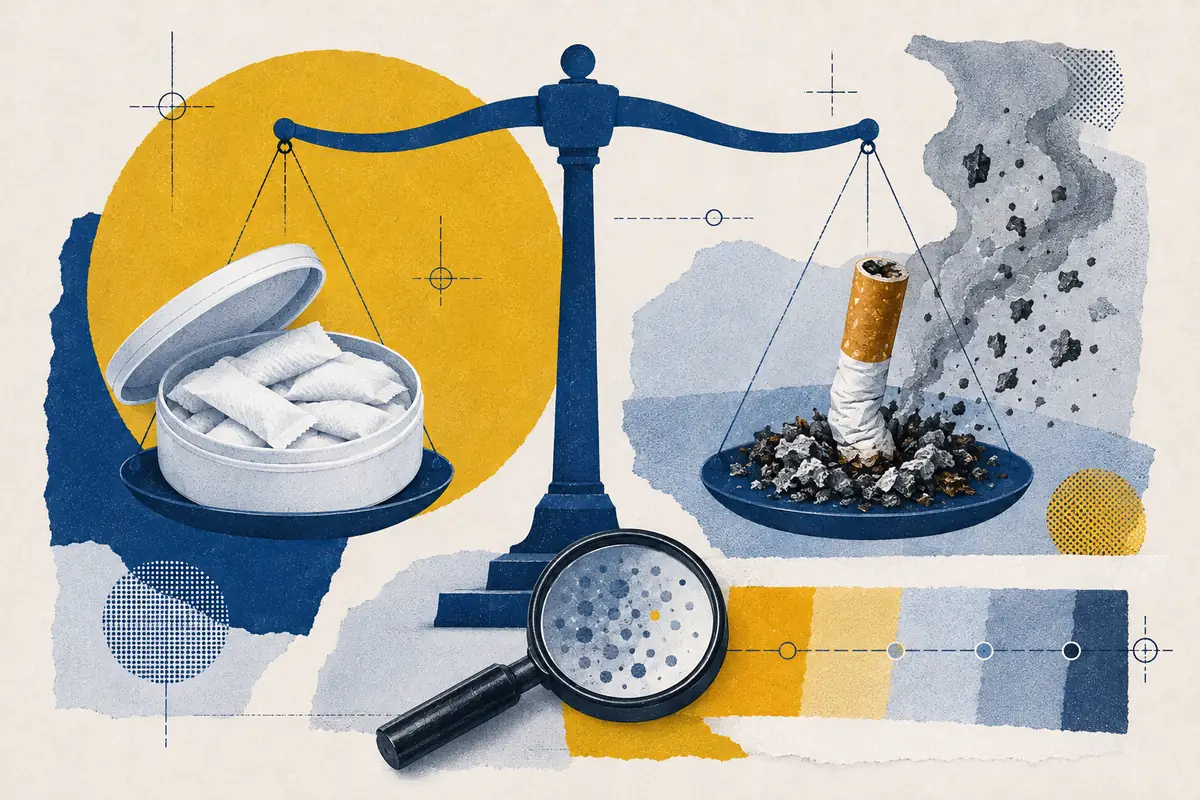
Probably lower risk than continued cigarette smoking when used as a complete replacement, because pouches do not burn tobacco or produce smoke. They are not harmless, the size of any risk reduction is uncertain, and long-term pouch-specific health outcomes remain insufficiently studied.
Document typeEvidence Review
Length1,608 words
Key Findings
- Pouches avoid combustion, the process responsible for many of smoking’s toxic exposures.
- The UK Committee on Toxicity considers lower overall risk plausible when pouches replace cigarettes completely.
- Dual use can increase or prolong nicotine exposure and should not be treated as equivalent to complete switching.
Why might pouches present less risk than cigarettes?
Cigarette smoke contains toxic products created by burning tobacco. Nicotine pouches deliver nicotine without smoke or inhalation. That removes a major pathway of harm, but it does not remove the effects of nicotine or possible effects from prolonged contact with pouch ingredients.
The UK Committee on Toxicity concluded that lower overall risk is plausible when appropriately manufactured pouches are used as recommended in place of cigarettes. It also stressed that the magnitude of reduction depends on the health outcome being considered.
Why does the answer remain qualified?
Pouch-specific longitudinal evidence is still limited. The products vary in nicotine concentration, pH and formulation, and some can produce nicotine exposure comparable with smoking. Long-term oral and cardiovascular outcomes cannot yet be stated with the confidence available for cigarettes.
“Lower risk than smoking” is a comparison, not a declaration of safety. It does not make initiation advisable for someone who does not use nicotine.
What makes cigarette smoking such a demanding comparator?
Smoking is not simply nicotine use. Burning tobacco creates a complex smoke mixture and delivers toxicants to the lungs repeatedly. Decades of epidemiology connect that exposure to cancer, cardiovascular disease, respiratory disease and premature death. A comparison with cigarettes therefore starts from an unusually harmful reference product, not from a harmless baseline.
Pouches avoid combustion and inhalation. That provides a strong mechanistic reason to expect lower exposure to many smoke-related toxicants. It does not remove nicotine, local oral contact or formulation-specific constituents, and it cannot by itself quantify the probability of each disease outcome. “Lower than smoking” and “low in absolute terms” are different propositions.
The relevant comparison also depends on behaviour. A smoker who replaces every cigarette creates a different exposure pattern from someone who adds pouches while continuing to smoke. Studies and public claims that do not distinguish complete switching, dual use and initiation can produce conclusions that sound precise but answer different questions.
What did the UK Committee on Toxicity conclude?
The UK Committee on Toxicity reviewed ingredients, nicotine bioavailability and available toxicological evidence. It regarded pouches as capable of delivering a pharmacologically active dose and rejected the idea that they are harmless. It also considered lower overall risk plausible when appropriately manufactured products replace conventional cigarettes, while emphasizing uncertainty and outcome-specific differences.
That wording matters. A committee can reasonably infer a lower overall risk from removal of combustion while declining to assign a percentage reduction. Cancer, cardiovascular effects, oral outcomes, pregnancy and dependence do not share one risk ratio. Product variability and limited long-term data further weaken any universal number.
The COT also drew attention to high nicotine content and the possibility that concurrent use could increase exposure. Its analysis is best read as a structured comparative assessment, not a blanket endorsement. It supports cautious harm comparison for existing smokers while retaining warnings for non-users and vulnerable groups.
What health risks remain when smoke is removed?
Nicotine remains addictive and can affect cardiovascular function. It is hazardous during pregnancy and to the developing adolescent brain. Pouch users may also experience local irritation and other short-term effects. Removing smoke changes the risk profile, but it does not turn exposure into a wellness product.
Long-term pouch-specific evidence remains limited because widespread use is recent. The absence of decades-long cohort results makes it difficult to quantify uncommon diseases or cumulative oral effects. Researchers must also account for prior smoking, concurrent product use, strength, frequency and duration, all of which can confound comparisons.
The evidence is strongest on the harms of smoking and on the absence of many combustion toxicants when nothing is burned. It is much weaker on the exact residual risk of each modern pouch over decades. Those differences in certainty limit any numerical comparison.
Why does complete switching matter?
Most of the comparative benefit hypothesized for pouches comes from cigarettes no longer being smoked. If a person continues to smoke, even less frequently, they retain some smoke exposure. The relationship between cigarette count and disease is not always linear, so cutting consumption cannot automatically be translated into an equivalent percentage reduction in harm.
Dual use may also sustain dependence or increase total nicotine intake. A pouch can be used where smoking is inconvenient, allowing nicotine exposure across more of the day. That behaviour may help some adults move away from cigarettes, but it may also delay cessation or create a stable pattern of using both products.
Studies should state whether participants switched completely, reduced smoking, used pouches occasionally or had never smoked. Without those categories, average outcomes obscure the pathway that generated them. Consumer-facing claims should use the same discipline.
How should relative and absolute risk be communicated?
Relative-risk statements compare two options; absolute-risk statements ask how much harm remains. For an adult who would otherwise continue smoking, a lower-risk substitute may be relevant. For a person who uses no nicotine, starting pouches creates risk without replacing cigarette exposure. The same product can therefore produce different public-health judgments for different groups.
Numbers can imply more certainty than the evidence supports. A single percentage may combine unlike outcomes, borrow from another product category or rely heavily on modelling assumptions. When a credible authority makes a narrower product-specific finding, it should be quoted within its legal and evidentiary boundaries rather than generalized.
The most useful formulation names the comparator, behaviour and uncertainty: lower risk than continued smoking is plausible when pouches replace cigarettes completely; pouches are not harmless; and the magnitude and long-term outcome profile remain uncertain. That sentence is less dramatic than a slogan and substantially more informative.
Where do WHO and harm-reduction advocates disagree?
WHO emphasizes addiction, youth-oriented marketing, regulatory gaps and the danger that commercial actors appropriate the language of harm reduction. Its position calls for comprehensive controls and resists treating mass-marketed nicotine products as a public-health programme. This perspective focuses on population effects, industry conduct and non-user uptake.
Harm-reduction advocates place more weight on the large risk difference between combustion and non-combustion for adults who smoke. They argue that overly restrictive rules may protect the cigarette market or deny adults a less harmful alternative. That argument is strongest when it concerns complete switching by established smokers and weakest when it becomes undifferentiated lifestyle promotion.
The disagreement is partly empirical and partly about governance. Both sides can agree that young people should not initiate, smoking is exceptionally harmful, and product quality matters while disagreeing about flavours, claims, access and the proper role of commercial products. A credible report should show that structure rather than selecting quotations from only one camp.
What evidence would justify a stronger conclusion?
A stronger estimate would require long-term cohorts with verified product use, careful adjustment for smoking history, and enough follow-up to observe major outcomes. It would also require stable product characterization: nicotine release, constituents, pH and use frequency. Results from one brand or strength should not silently represent the category.
Randomized trials can answer switching and short-term exposure questions but are usually too small or brief for chronic disease. Biomarker studies can show reduced exposure to selected toxicants, yet exposure reduction is not automatically equal to disease-risk reduction. Multiple evidence streams must converge.
Until then, decisions must be made under uncertainty. The appropriate response is not paralysis or certainty theatre; it is a bounded conclusion, active surveillance, product standards, youth protections and revision when better evidence arrives.
Frequently Asked Questions
1. Does tobacco-free mean harmless?
No. It means the product contains no tobacco leaf. Nicotine is addictive, and long-term pouch-specific risks remain under study.
2. What if someone uses pouches and continues smoking?
Concurrent use can increase or prolong total nicotine exposure and does not provide the same basis for a reduced-risk comparison as complete replacement.
3. Can the exact reduction in risk be quantified?
Not reliably from current evidence. Risk differs by outcome, product formulation, dose and use pattern.
4. Are pouches safer than not using nicotine?
No comparative-risk rationale supports initiation by a non-user. Avoiding nicotine exposure remains the lower-risk option.
5. Did the FDA declare all pouches safe?
No. It authorized specific products for marketing under a population-health standard and expressly stated that authorization does not mean safe or FDA approved.
6. Does smoking fewer cigarettes remove most smoking risk?
Not necessarily. Disease risk does not always fall in direct proportion to cigarette count, which is why complete switching is analytically different from reduction or dual use.
7. Can long-term risk be stated as a percentage?
Current pouch-specific evidence does not support one universal percentage across diseases, products and use patterns.
Primary and authoritative sources
Source trail
- [1]UK Committee on ToxicityStatement on the toxicological risks of oral nicotine pouches
- [2]US Centers for Disease Control and PreventionNicotine pouches: product, use and health effects
- [3]World Health OrganizationPosition on tobacco control and harm reduction
- [4]US Food and Drug AdministrationScientific review and authorization of ZYN products
- [5]US Food and Drug AdministrationNicotine pouch products authorized by the FDA
- [6]World Health OrganizationGlobal report on nicotine-pouch marketing and regulation
- [7]
- [8]UK ParliamentTobacco and Vapes Act 2026: explanatory notes