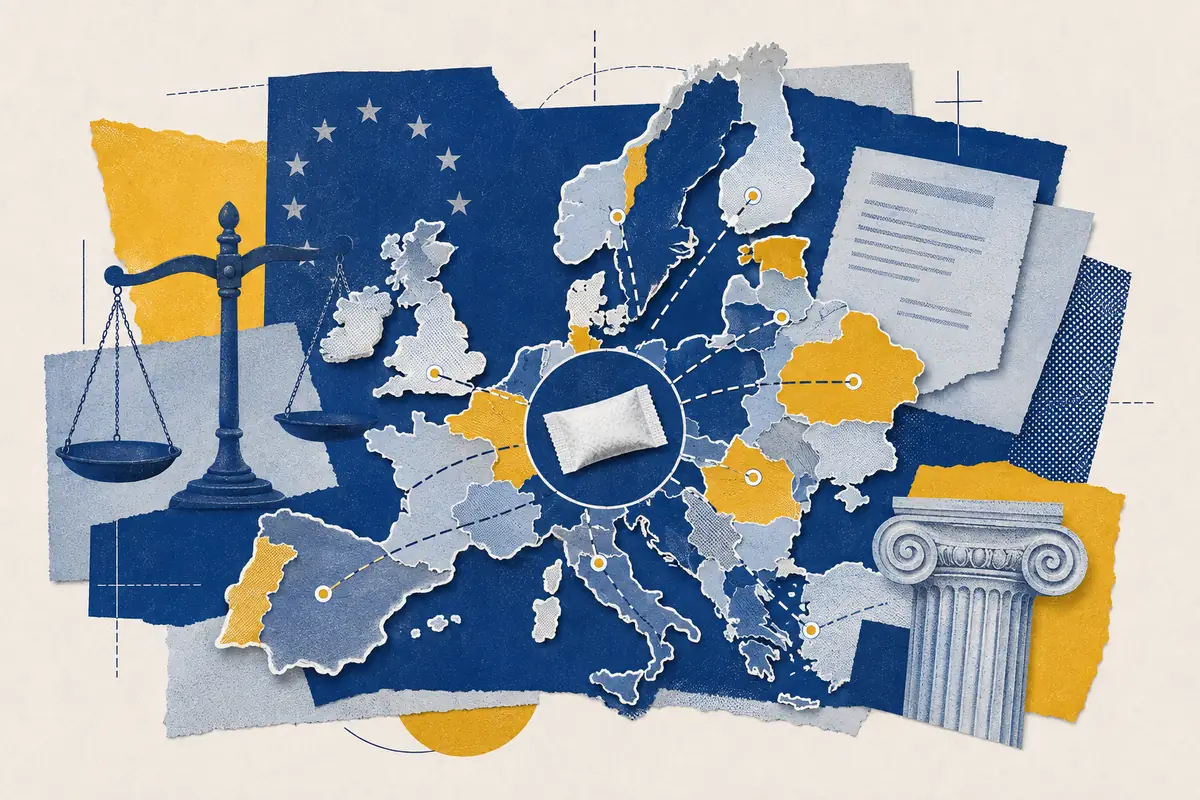
No dedicated EU-wide nicotine-pouch regime currently determines sale, strength, flavours, age limits and advertising across every Member State. The European Commission states that tobacco-free pouches fall outside the Tobacco Products Directive and are not food. A pouch may instead be a medicine or otherwise fall under general product-safety law, while Member States adopt different national restrictions consistent with EU law.
Document typePolicy Explainer
Length1,582 words
Key Findings
- Tobacco-free nicotine pouches are currently outside the scope of the EU Tobacco Products Directive.
- The Commission also considers products intended for oral nicotine absorption not to be food.
- Medicinal presentation or function can bring a product within medicines law; otherwise general product-safety rules may apply.
- National sale, strength, flavour, age and marketing rules therefore differ and must be checked separately.
Why does the Tobacco Products Directive not provide one answer?
Directive 2014/40/EU regulates defined tobacco and related products, but the Commission has stated that tobacco-free nicotine pouches do not contain the tobacco leaf, dust or stems needed for its tobacco-product definitions. They are therefore outside the Directive’s current scope.
That exclusion is not permission to sell everywhere. It means the dedicated harmonized tobacco framework does not supply the complete pouch rule, leaving other EU legislation and national measures to do the regulatory work.
Which EU-level rules can still matter?
If a product qualifies as a medicinal product by presentation or function, medicines law applies and marketing authorization may be required. If it is not a medicine, the General Product Safety Regulation can impose safety, traceability, warning and recall duties on economic operators.
Internal-market, consumer-protection, distance-selling, data-protection and customs rules can also affect a transaction without creating a harmonized right to sell the pouch itself. Product status and transaction rules must remain separate.
What does “no harmonized EU regime” mean?
Harmonization means EU legislation sets common rules that Member States implement or apply within defined limits. Cigarettes, roll-your-own tobacco, oral tobacco and electronic cigarettes have substantial common treatment under the Tobacco Products Directive. Tobacco-free nicotine pouches do not currently have an equivalent dedicated chapter.
The Commission confirmed in a 2025 parliamentary answer that pouches are outside Directive 2014/40/EU. Its October 2025 Standing Committee discussion explained the definitional reason: the products do not contain tobacco leaf, dust, stems or other parts required by the Directive’s tobacco-product concepts.
The consequence is fragmentation, not a legal vacuum. National legislatures and regulators can prohibit sale, create a nicotine-product category, apply medicines law or rely on general safety rules. Their measures remain constrained by applicable EU law, including internal-market principles.
A Europe-wide answer must therefore identify the legal layer. “Not regulated by the TPD” describes one directive; it does not describe every EU regulation, national statute, administrative decision or border rule that can affect the product.
Why does the food-law question arise?
Pouches contain sweeteners, flavours and plant fibres that may also be used in food. That ingredient overlap has led some authorities and businesses to ask whether general food legislation supplies a regulatory route.
The Commission’s Standing Committee discussion referred to the EU definition of food and concluded that nicotine pouches intended for oral absorption should not be treated as food. The intended delivery of nicotine, rather than accidental swallowing of saliva, is central to that view.
Classification is about the finished product’s intended function, presentation and composition, not the fact that one ingredient has a food use. Calling ingredients “food grade” does not transform a nicotine-delivery pouch into food.
The Committee record is an authoritative statement of the Commission’s view, but courts retain the final authority to interpret EU law in a dispute. A careful report should preserve that institutional distinction.
When can medicines law apply?
A pouch may be a medicinal product if it is presented as treating or preventing disease or if its pharmacological action and intended function meet the legal definition. Smoking-cessation claims are particularly relevant because they describe a therapeutic purpose.
Classification is product-specific. A licensed nicotine-replacement pouch and a consumer pouch can have a similar physical form but different claims, evidence, instructions and authorization status. Appearance cannot transfer the legal status of one to the other.
Where a product qualifies as a medicine, authorization, manufacturing quality, pharmacovigilance, advertising and supply rules follow the medicines framework. A retailer cannot obtain that status simply by adding health language to a product page.
Member State competent authorities make classifications in concrete cases, subject to EU law and judicial review. Borderline-product disagreements are therefore possible, and a commercial listing should not substitute its own preferred category.
What does general product-safety law contribute?
For consumer products not covered by a more specific regime, Regulation (EU) 2023/988 establishes general safety and traceability duties. It addresses responsible economic operators, risk assessment, warnings, online marketplace cooperation, recalls and information for consumers.
The General Product Safety Regulation is a safety net, not a pouch code. It does not itself create one harmonized nicotine ceiling, flavour list, tax rate or minimum age for every Member State.
A product can satisfy documentation duties and still be prohibited nationally. Conversely, absence of a national pouch-specific statute does not remove the general duty to place only safe consumer products on the market.
Online sellers should identify the manufacturer and EU responsible person where required, provide warnings and cooperate with corrective action. Those obligations do not guarantee that a destination country permits the sale.
How can national measures differ?
Member States have used different tools: complete sales bans, dedicated tobacco-free nicotine categories, nicotine-content limits, flavour restrictions, health warnings, child-resistant packaging, notification schemes, advertising controls, age limits and excise taxes.
The rules also have different dates and transitions. A law may be enacted but await commencement, grandfather existing stock or phase in packaging requirements. A proposal or political announcement is not the same as an operative restriction.
National measures must comply with EU obligations, including proportionality and notification requirements where applicable. That constraint does not mean every country must reach the same policy outcome.
A country page should cite the operative national text and specify physical retail, domestic online sale, postal import, traveller import and possession separately. A broad “EU legal” badge cannot safely collapse those routes.
Does free movement guarantee cross-border ordering?
No. Free movement is a foundational EU principle, but Member States may justify proportionate restrictions for public-health and consumer-protection objectives. Whether a particular measure is lawful requires analysis of its scope, justification and application.
A product lawfully marketed in one Member State is not automatically deliverable to consumers in another when the destination has a ban, registration rule, strength limit or distance-selling restriction. Mutual-recognition questions are fact- and law-specific.
The seller’s location, buyer’s destination, dispatch route and importer of record can determine which obligations arise. A courier accepting a parcel proves logistics only; it does not adjudicate legal entitlement or customs treatment.
Retailers should therefore avoid “ships to” as a synonym for “legal in.” The defensible link is to a current destination-specific evidence page with date, sources and route distinctions.
Could future EU legislation change the answer?
Yes. The Commission has been evaluating tobacco-control legislation and the rapidly changing nicotine market. A proposal could bring pouches into a revised directive or create another harmonized framework, but consultation or evaluation does not alter current law by itself.
The legal sequence matters: proposal, legislative negotiation, adoption, publication, transposition where relevant, national implementation and commencement. A site should update at the stage that changes the relevant legal answer, not at the first news headline.
A future harmonized instrument may still leave national discretion over tax, retail licensing, age enforcement or stricter health measures. “EU regulated” would not necessarily mean identical practice in every country.
This report should therefore be versioned when an adopted act changes scope. Until then, the bounded conclusion remains that no single dedicated EU-wide pouch regime supplies the complete consumer answer.
Frequently Asked Questions
1. Does legality in one EU country make sale legal in another?
No. National product restrictions can differ, and cross-border trade remains subject to the destination country’s rules and EU law.
2. Are nicotine pouches food?
The European Commission’s stated view is that products intended to release nicotine for oral absorption do not qualify as food.
3. Can a nicotine pouch be a medicine?
Yes, depending on its presentation, intended purpose and pharmacological function under the applicable medicines framework.
4. Does the EU tobacco directive ban nicotine pouches?
No. The current Directive does not specifically govern tobacco-free nicotine pouches; national and other legal regimes determine their status.
5. Is snus law a reliable proxy for pouch law?
No. Snus contains tobacco and falls within the Tobacco Products Directive’s oral-tobacco rules; tobacco-free pouches have a different current classification.
6. Can a Member State ban pouches even without an EU ban?
Potentially yes, subject to EU-law requirements such as proportionality, free movement and any applicable notification procedure.
7. Does CE marking apply to ordinary nicotine pouches?
CE marking applies only where specific EU harmonization legislation requires it. It is not a general consumer-product safety certificate for ordinary pouches.
8. Who gives the final interpretation of EU law?
National courts apply EU law in cases and can refer questions to the Court of Justice of the European Union, whose interpretations are authoritative.
Primary and authoritative sources
Source trail
- [1]European CommissionAnswer on the EU legal position of nicotine pouches
- [2]European CommissionStanding Committee discussion of tobacco-free nicotine pouches
- [3]European UnionGeneral Product Safety Regulation (EU) 2023/988
- [4]European UnionTobacco Products Directive 2014/40/EU
- [5]World Health OrganizationGlobal report on nicotine-pouch marketing and regulation