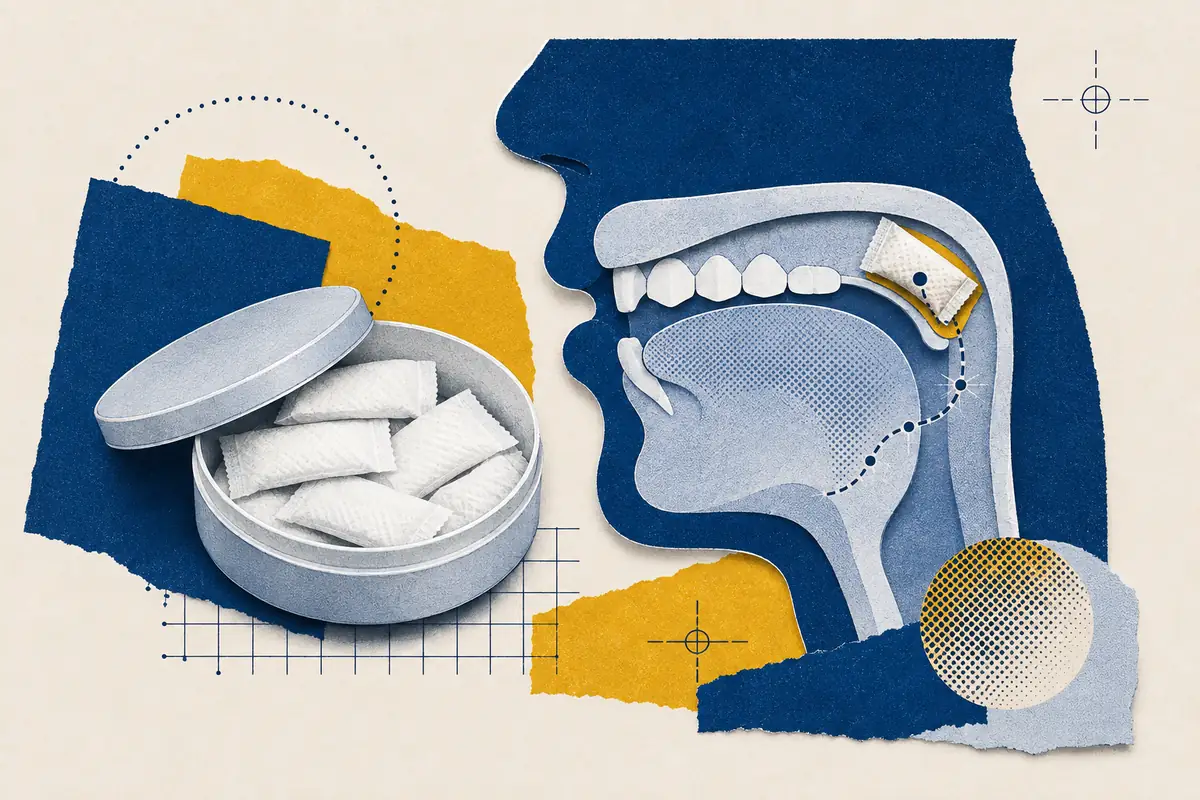
Nicotine pouches are small oral products placed between the lip and gum. They contain nicotine, flavourings and other ingredients but no tobacco leaf. Nicotine is absorbed through the lining of the mouth. They are addictive and are not intended for people who do not already use nicotine.
Document typeExplainer
Length1,874 words
Key Findings
- A pouch releases nicotine into saliva for absorption through the oral lining.
- “Tobacco-free” describes the absence of tobacco leaf; it does not mean nicotine-free or risk-free.
- Nicotine content varies substantially between products, making per-pouch labelling important.
How does a nicotine pouch deliver nicotine?
The pouch sits between the upper lip and gum. Moisture allows nicotine and flavour compounds to leave the pouch, after which nicotine is absorbed through the oral mucosa. The pouch is removed and discarded after use rather than burned, inhaled or chewed.
The absence of combustion is an important physical distinction from cigarettes. It does not answer every health question: dose, formulation, frequency of use and concurrent use of other nicotine products all affect exposure.
What does “tobacco-free” actually mean?
Nicotine pouches do not contain tobacco leaf. Their nicotine may be extracted from tobacco or produced synthetically. The US Centers for Disease Control and Prevention notes that there is little chemical difference between tobacco-derived and synthetic nicotine.
The description is therefore about ingredients and classification, not a safety certification. Nicotine remains pharmacologically active and addictive.
What is actually inside a nicotine pouch?
A typical pouch combines nicotine with a cellulose or other plant-fibre carrier, water, flavourings, sweeteners, stabilisers and compounds that influence acidity. That description is a category sketch, not a universal recipe. Formulations differ by manufacturer and market, and the ingredient list does not by itself reveal how quickly nicotine becomes available to the user. Product-specific labels and regulatory filings therefore matter more than assumptions based on appearance.
The nicotine may be extracted from tobacco or made synthetically. The finished pouch contains no tobacco leaf, but the pharmacologically active nicotine molecule performs the same basic function regardless of origin. “Synthetic,” “tobacco-derived” and “tobacco-free” answer different questions: origin, composition and legal classification. None is a health-risk rating.
Moisture, pouch material, particle size, flavour system and pH can all affect the sensory experience and release profile. Two cans displaying the same milligrams per pouch need not feel identical or produce an identical time course of exposure. Consumers and researchers should therefore avoid treating a single number as a complete description of product performance.
How is nicotine absorbed through the mouth?
Once placed between lip and gum, the pouch becomes wet with saliva. Nicotine leaves the pouch and crosses the oral mucosa before entering systemic circulation. This is buccal absorption: the product is not intended to be swallowed, smoked or inhaled. Some dissolved nicotine may nevertheless be swallowed with saliva and then undergo a different absorption pathway through the gastrointestinal tract.
The speed and amount absorbed depend on more than the printed nicotine content. Acidity influences the proportion of nicotine in a form that passes through tissue; contact time, saliva production, user behaviour and pouch construction also matter. Laboratory content, released dose, absorbed dose and peak blood concentration are related measurements, but they are not interchangeable.
A content label cannot predict an individual experience with precision. Comparisons with cigarettes, gum, lozenges or snus require pharmacokinetic evidence because product formulation and user behaviour change both the rate and amount of nicotine delivered.
How should nicotine strength be read?
Strength may be expressed as milligrams per pouch, milligrams per gram, a descriptive tier, or some combination of these. The most immediately useful figure for comparing individual portions is milligrams per pouch. Milligrams per gram can be informative when pouch weights differ, but it can mislead if a reader mistakes it for the dose in one pouch.
Terms such as “regular,” “strong,” “extra strong” and “expert” are not stable scientific units. A tier used by one brand may overlap a different tier used by another. The WHO has drawn attention to very high strengths and to presentation systems that can normalize escalation. Clear numerical labelling is therefore a basic consumer-protection measure, especially where products from several markets appear together online.
The printed amount still describes content rather than guaranteed absorption. It should be combined with pouch count, net weight, ingredient information and any official product authorization relevant to the country of sale. A retailer who displays only an unexplained strength symbol makes informed comparison harder than it needs to be.
How are pouches different from cigarettes, vapes and nicotine medicines?
Cigarettes burn tobacco and create smoke; vapes heat a liquid to create an aerosol; pouches release nicotine in the mouth without combustion or inhalation. That physical difference changes exposure pathways and risk questions. It does not establish that every pouch is low risk, nor does it tell us whether a person will replace smoking completely or use several products together.
Nicotine gum, lozenges and some authorized pouches may be regulated as medicines or cessation aids when they are submitted with therapeutic claims and evidence. Consumer nicotine pouches are often marketed without that therapeutic status. The same broad dosage form can therefore sit inside a medicines regime in one context and a tobacco or consumer-product regime in another.
The US CDC states that nicotine pouches are not approved there as a smoking-cessation aid. Health Canada, by contrast, has authorized a limited number as nicotine-replacement products under its health-product framework. The difference is not merely semantic: authorization, permitted claims, distribution and instructions for use depend on the governing pathway.
What immediate effects and warning signs matter?
Nicotine can produce effects such as increased heart rate, nausea, dizziness, headache or hiccups, particularly in nicotine-naive users or after a high exposure. Local irritation may occur where the pouch rests against oral tissue. These observations do not establish the frequency or long-term significance of every effect, but they are reasons to take product strength and individual tolerance seriously.
A pouch should be kept away from children and animals. Accidental ingestion can create poisoning risk, and attractive flavours or small containers can increase the importance of secure storage. Severe symptoms or suspected poisoning require prompt contact with local emergency or poison-control services rather than reliance on an online article.
Pregnant people, adolescents, young adults and people who do not use nicotine are consistently identified by public-health authorities as groups who should not begin using these products. An adult-only label is not a complete safeguard; packaging, marketing, placement, age verification and responsible disposal all shape real-world access.
Why is the history of the category easy to misread?
Modern nicotine pouches borrow the portion format associated with Scandinavian snus, but remove tobacco leaf from the filling. Their market history is much shorter than the history of smoking or oral tobacco. That means population-level disease outcomes have had less time to emerge and be measured, while product designs have changed rapidly.
Short market history creates two opposite errors. Enthusiasts may treat absence of long-term evidence as proof of safety; critics may treat uncertainty as proof that risk equals smoking. Neither follows. The defensible position is to separate what is already known about nicotine and route of exposure from what remains unknown about decades of pouch-specific use.
Regulators also inherit laws written before the category existed. A statute may define tobacco products by ingredient, nicotine products by intended use, or medicines by therapeutic claims. The resulting legal answer can reflect drafting history as much as toxicology. This is why definitions belong in any serious account of what the product “is.”
What does responsible use language need to avoid?
A neutral description should not become a beginner’s guide for nicotine initiation. Product information can explain composition, labelling and risk without recommending flavours, escalation strategies or ways to conceal use. The proper audience distinction is between adults who already use nicotine and people for whom initiation creates a new avoidable exposure.
It should also avoid implying that “smoke-free” means medically endorsed. Smoke-free accurately describes the route; it does not describe addiction potential, oral effects, pregnancy risk or long-term uncertainty. Likewise, an official marketing authorization applies to specific products and claims in a specific jurisdiction, not to the entire global category.
Finally, responsible language should keep cessation evidence separate from commercial substitution claims. Where approved cessation medicines and counselling are available, public-health agencies direct smokers toward those evidence-based options. A consumer pouch can be discussed comparatively without being promoted as an approved treatment.
Which unknowns are most important for future research?
Longitudinal studies are needed to observe oral, cardiovascular and dependence outcomes over years rather than days or weeks. Researchers also need representative data on who starts, who switches completely, who becomes a dual user and who stops all nicotine. Those behavioural pathways determine population effects as much as chemistry does.
Product surveillance should track nicotine content, release, pH, impurities, packaging, flavours and consistency between batches. Studies should identify products precisely instead of treating “nicotine pouch” as a single exposure. Independent replication and disclosure of industry funding are especially important in a market where commercial and public-health narratives sharply diverge.
Better comparative work would connect laboratory measurements with actual patterns of use and clinically meaningful outcomes. Until that evidence matures, the strongest answers will remain layered: confident about composition and route, qualified about comparative risk, and cautious about long-term effects.
Frequently Asked Questions
1. Do nicotine pouches contain tobacco?
They do not contain tobacco leaf. The nicotine itself may be derived from tobacco plants or manufactured synthetically.
2. Do nicotine pouches require spitting?
No. The pouch remains under the lip while nicotine is absorbed through the oral lining.
3. Who should not use nicotine pouches?
They should not be used by children, adolescents, pregnant people, or people who do not already use nicotine. Anyone with health concerns should seek advice from a qualified clinician.
4. Can a pouch be swallowed?
It is designed to sit between the lip and gum and then be removed. Accidental ingestion, especially by a child or animal, can create a poisoning risk; contact local poison-control or emergency services for case-specific advice.
5. Is synthetic nicotine a different drug?
The source is different, but the nicotine molecule has essentially the same pharmacological activity. “Synthetic” should not be interpreted as non-addictive or automatically safer.
6. Does the printed milligram amount equal the absorbed dose?
No. It states product content. Release and absorption vary with formulation, pH, contact time and user factors.
7. Are pouches approved to help people quit smoking?
That depends on product and jurisdiction. They are not FDA-approved cessation aids in the United States, while Canada has authorized a small number within its nicotine-replacement framework.
Primary and authoritative sources
Source trail
- [1]US Centers for Disease Control and PreventionNicotine pouches: product, use and health effects
- [2]UK Committee on ToxicityStatement on the toxicological risks of oral nicotine pouches
- [3]World Health OrganizationNicotine pouch evidence and youth warning
- [4]World Health OrganizationGlobal report on nicotine-pouch marketing and regulation
- [5]US Food and Drug AdministrationNicotine pouch products authorized by the FDA
- [6]US Food and Drug AdministrationScientific review and authorization of ZYN products
- [7]
- [8]
- [9]World Health OrganizationPosition on tobacco control and harm reduction