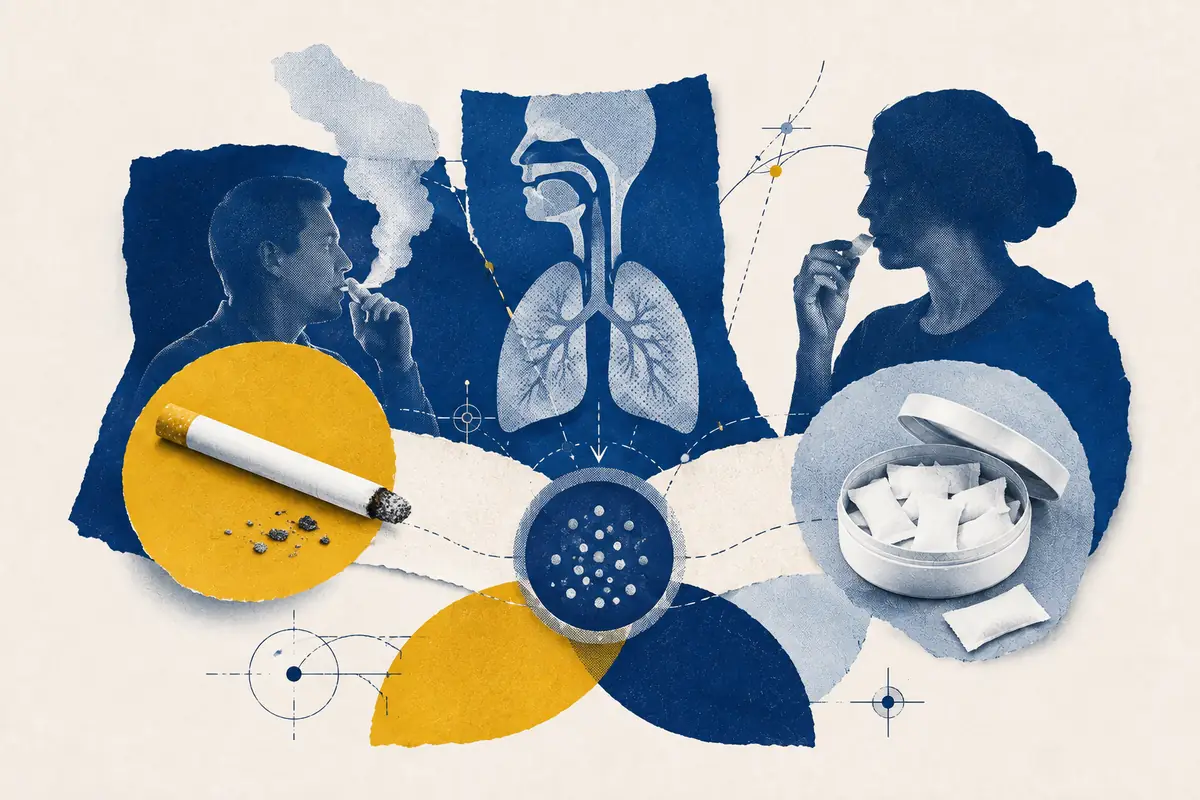
Dual use is not equivalent to complete switching. Pouches can add nicotine and allow use where smoking is impossible while cigarettes continue to supply combustion toxicants. Smoking fewer cigarettes may lower some exposures, but risk does not necessarily fall in proportion to cigarette count. The largest reduction in smoke-related exposure requires stopping cigarettes completely.
Document typeEvidence Review
Length1,566 words
Key Findings
- Dual use describes concurrent products, not one stable level of risk; frequency and transition over time are essential.
- Cigarette smoke remains the principal source of combustion toxicants while smoking continues.
- Nicotine exposure can remain high or increase when pouches supplement rather than replace cigarettes.
- Current pouch trials do not establish that dual use reliably progresses to sustained smoking cessation.
What patterns are hidden inside “dual use”?
One person may use pouches briefly while moving toward a quit date; another may replace most cigarettes but retain a few; a third may smoke at the same rate and add pouches at work or during travel. All meet a broad dual-use definition, yet their nicotine and toxicant exposures differ substantially.
Research should therefore record cigarettes and pouches per day, duration, context, product strength and change over time. A one-time label cannot distinguish a temporary transition from a stable pattern that extends nicotine use into more hours of the day.
Why is complete switching different?
Cigarettes generate toxicants through combustion. Complete switching removes that continuing source, whereas partial substitution preserves it. Even low levels of smoking carry meaningful health risk, and cardiovascular risk in particular does not decline linearly with cigarettes per day.
This does not mean smoking reduction has no value. It can lower some biomarkers and be part of a transition. It means that a reduced cigarette count should not be advertised as if it delivered the exposure profile of verified abstinence.
How should dual use be measured?
At minimum, a study needs the number of cigarettes and pouches used on each day, the strength and identity of pouches, duration of use and other nicotine products. “Current use” of both during the past 30 days could describe one pouch and one cigarette or intensive daily co-use.
Sequence matters. Baseline smoking, first pouch use, periods of reduction, quit attempts, relapse and complete switching should be dated. Repeated measures can show whether dual use is transitional or persistent; a cross-sectional survey cannot.
Biomarkers add verification but have different windows. Carbon monoxide reflects recent combustion, some tobacco-specific biomarkers persist longer, and nicotine metabolites cannot identify which nicotine product was used. No single specimen fully reconstructs a changing pattern.
What happens to nicotine exposure?
Pouches can produce nicotine exposure comparable with or greater than cigarettes depending on product and use. If a pouch replaces a cigarette, the daily nicotine pattern changes; if it fills smoke-free intervals, it may add exposure without reducing cigarettes. Tolerance can obscure the subjective increase.
A 2026 PATH biomarker analysis found exclusive pouch users had nicotine-metabolite levels comparable with exclusive cigarette smokers while having lower levels of selected tobacco alkaloids and lead. The study did not analyze every dual-use pattern, but it shows why smoke-toxicant reduction and nicotine reduction are different outcomes.
Researchers should not treat nicotine metabolites as a proxy for smoke exposure. A dual user can have high nicotine from both products while reducing some combustion biomarkers, or continue smoking enough that smoke-related exposures remain high.
What happens to combustion-toxicant exposure?
Pouches do not create smoke, so combustion toxicants in a dual user mainly come from cigarettes and other burned products. Reducing cigarette consumption can lower some biomarkers, but compensation, deeper inhalation or smoking more of each cigarette, can weaken the relationship between count and dose.
PATH research on cigarette reduction found that changes in cigarettes per day often produced limited or inconsistent changes in some exposure biomarkers compared with complete cessation. That evidence is not pouch-specific, but it cautions against treating a self-reported count reduction as a measured toxicant reduction.
Product-specific trials should measure carbon monoxide and relevant urinary or blood biomarkers alongside daily diaries. A reduction claim should name the biomarker, magnitude, time window and comparator instead of saying that dual use “removes toxins.”
Why is cardiovascular risk not proportional to cigarette count?
A meta-analysis of 141 cohort studies found that smoking about one cigarette per day carried a much larger fraction of the excess coronary-heart-disease and stroke risk of 20 cigarettes per day than a simple one-twentieth assumption. The dose-risk curve is notably nonlinear for these outcomes.
The result concerns cigarette smoking, not pouches. Its relevance is that retaining a few daily cigarettes can preserve substantial cardiovascular risk even if a pouch helps reduce the count dramatically. Complete switching and partial reduction should not share one risk label.
Risk varies by disease. Lung-cancer risk, cardiovascular risk and symptoms do not decline on identical curves. A universal percentage reduction based only on cigarettes per day is therefore inappropriate.
Could dual use be a useful transition?
Yes, for some individuals it may be a temporary route from smoking to complete cigarette abstinence. A product that manages withdrawal in settings where smoking previously occurred can support behavioural change. The important outcome is whether cigarettes end and remain absent.
Current Cochrane evidence includes only a handful of small, short pouch studies and remains uncertain about smoking cessation. One study can show reduced cigarette counts without establishing durable abstinence. Transition potential should therefore be described as plausible rather than proven.
A credible intervention would define a quit date or switching target, provide support, monitor both products and report relapse. Selling pouches without a transition plan may produce a different behaviour from testing them inside a structured trial.
How can dual use become persistent?
Pouches remove practical constraints on nicotine use. A person can smoke in permitted settings and use pouches in offices, vehicles, travel or around others. That complementary pattern may reduce pressure to stop cigarettes and extend nicotine exposure across the day.
Sensory and social cues differ between products, so dependence can become attached to both. Cigarettes may remain linked to breaks or alcohol while pouches support concentration or convenience. Treating one dependence pattern does not automatically dissolve the other.
Persistent dual use is not inevitable, and current prevalence data are still developing. Studies should avoid assuming either that all dual users are failed quitters or that all are in a successful transition. Duration and direction are empirical questions.
What should consumers, clinicians and publishers report?
Consumers tracking a switch can record daily cigarettes, pouches, strength, triggers and cigarette-free days. Clinicians should ask about all nicotine products and distinguish the goals of ending smoking, reducing nicotine and stopping all use. Those goals may occur in stages.
Research and commercial claims should reserve “complete switch” for sustained cigarette abstinence. “Reduced smoking,” “dual use” and “nicotine abstinence” need separate outcome fields. Where possible, biomarkers should verify the combustion endpoint.
Retailers should not promise that adding pouches reduces harm. They can accurately explain that pouches contain no tobacco leaf and produce no smoke during use, while directing adults who smoke toward evidence-based cessation support and avoiding initiation claims for non-users.
Frequently Asked Questions
1. Is smoking fewer cigarettes while using pouches harm reduction?
It may reduce some smoke exposure, but the amount varies and cannot be assumed proportional to cigarette count. Complete cessation of cigarettes produces the clearest reduction in combustion exposure.
2. Can dual use increase total nicotine exposure?
Yes. If pouches are added between cigarettes rather than replacing them, total nicotine exposure and the hours spent maintaining nicotine can rise.
3. Does dual use usually lead to quitting?
Current pouch-specific evidence is insufficient to establish that progression. Studies must follow users over time and verify sustained cigarette abstinence.
4. How should a study define complete switching?
It should prespecify a sustained period without cigarettes, preferably verify it with appropriate biomarkers, and report continued pouch and other nicotine use separately.
5. How long can dual use last before it is no longer transitional?
There is no universal cutoff. Studies should report duration and trajectory rather than assign intent from a single observation.
6. If carbon monoxide falls, has all risk fallen equally?
No. Carbon monoxide reflects one aspect of smoke exposure. Other toxicants, nicotine and disease risks have different measures and dose-response relationships.
7. Can pouches prevent compensatory smoking?
They may relieve withdrawal and reduce pressure to compensate for some users, but direct pouch-specific evidence is insufficient to assume that result.
8. Does one occasional cigarette matter after switching?
Any return can reinforce smoking cues, and even low-intensity smoking carries meaningful risk. A clinician or cessation service can help address lapses without treating them as inevitable failure.
Primary and authoritative sources
Source trail
- [1]Cochrane Tobacco Addiction GroupOral nicotine pouches for cessation or reduction
- [2]Nicotine & Tobacco ResearchBiomarkers of exposure among adult nicotine-pouch users
- [3]
- [4]US Centers for Disease Control and PreventionNicotine pouches: product, use and health effects
- [5]
- [6]Hartmann-Boyce et al., Cochrane Database of Systematic ReviewsOral nicotine pouches for cessation or reduction of other tobacco or nicotine use
- [7]Nicotine & Tobacco ResearchChanges in cigarettes per day and biomarkers of exposure in PATH
- [8]US Surgeon GeneralSmoking Cessation: A Report of the Surgeon General